Z. LISIMULATION & CAPACITY SYSTEMSTHOUSAND OAKS, CAREV 2026.08
Portfolio — Rev 2026.08
Zhekai Li Platform Engineering
Simulation · Capacity Planning · Data Systems
I build the internal software that decides where a semiconductor fab puts its money and its
machines. Over the last three years that has meant replacing spreadsheet-driven planning with
production systems — a multi-scenario capacity engine, an ETL framework, a
protocol server unifying twenty production databases, and five web applications now used daily
across six manufacturing sites in three countries. The common thread is turning
fragmented operational data into decisions people actually trust.
20
Databases integrated
33
MCP tools shipped
965
Curated findings
54
Analysis reports
5
Web applications
6
Fab sites served
§01
Systems Built
05 entries
SYS-01 · PLANNING
Capacity Planning & Scenario Engine
The calculation engine and web application that replaced a legacy Excel capacity planning
process. Routes demand through product-family-specific paths to derive tool requirements,
inter-site equipment transfers, purchase recommendations and annual CapEx. Versioned
scenarios, side-by-side comparison, and Excel round-tripping so planners keep their
existing workflow. A multi-hour manual process now runs in under 15 minutes.
PythonFastAPIReactOracle
▸ Hours → <15 min
SYS-02 · DATA PLATFORM
Unified Data Access & Knowledge Platform
A 33-tool Model Context Protocol server giving programmatic, read-only access to
20 production databases across six sites — MES, data warehouse,
simulation platforms and capacity systems. Server-side SELECT-only enforcement, connection
lifecycle management, a vector-search store holding 965 curated engineering findings, and a
multi-user review pipeline that separates personal notes from published knowledge.
PythonMCPOracleSQL ServerChromaDB
▸ 20 DBs · 33 tools
SYS-03 · PIPELINES
ETL Framework
A deliberately small orchestration layer: YAML job configs, a generic source-to-target
runner, stage-and-swap refresh for zero-downtime table updates, run-history logged to a
database table, and CLI tooling for manual runs and inspection.
New pipelines require a config file, not code — so people who did not
write it can still extend it.
PythonYAMLOracleScheduler
▸ Config-driven
SYS-04 · APPLICATIONS
Internal Web Application Suite
Five production applications on a shared component design system, serving manufacturing,
planning and supply chain teams: fab-level Gantt and scheduling visualisation, multi-site
shipment forecasting, lot cycle-time exploration with simulation deep-links, simulation
delivery-accuracy scoring, and strategic capacity planning.
Full stack on each — extraction, API, frontend, deployment, adoption.
ReactTypeScriptFastAPIOracle
▸ 5 apps in daily use
SYS-05 · VALIDATION
Simulation Accuracy & Validation Pipeline
Automated comparison pipelines that reconcile simulation output against historical
production data across multiple granularities, separate systematic bias from noise, and
triage every discrepancy into input-data issue, known model gap, or real-world change.
The red-flag list is the vendor's model-correction backlog.
PythonOracleStatistics
▸ +30% CT forecast accuracy
§02
Analysis Work
7 of 54
Redacted
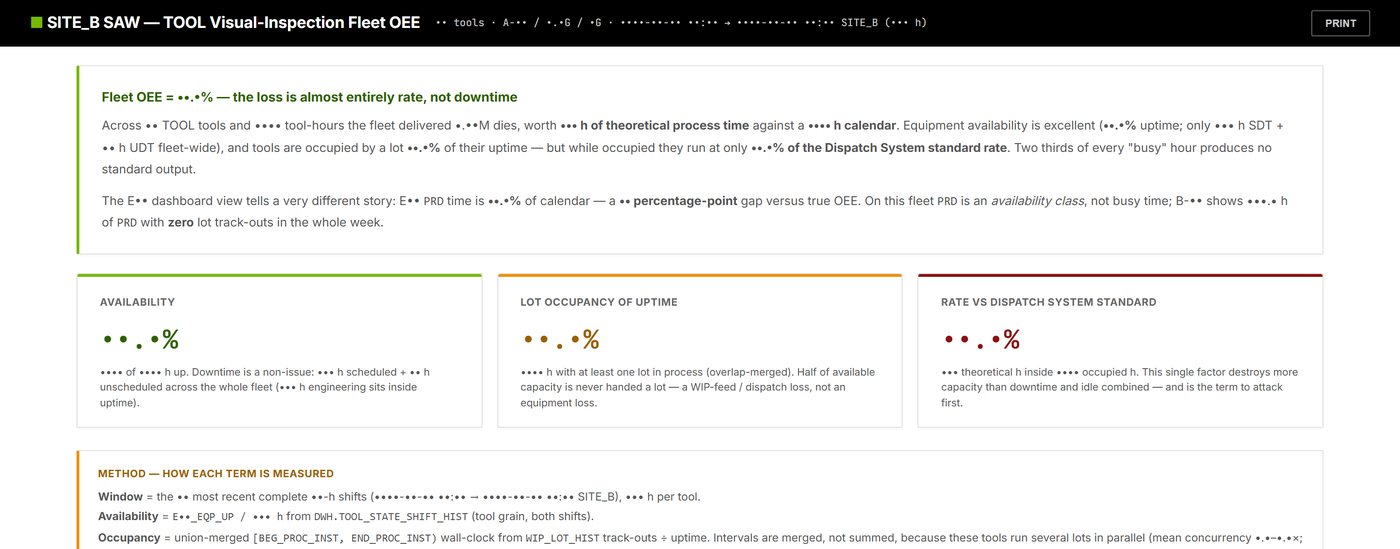
FLEET OEE DECOMPOSITION23-tool inspection fleet; availability 96.5% but rate 32% — the loss is rate, not downtimeRedacted
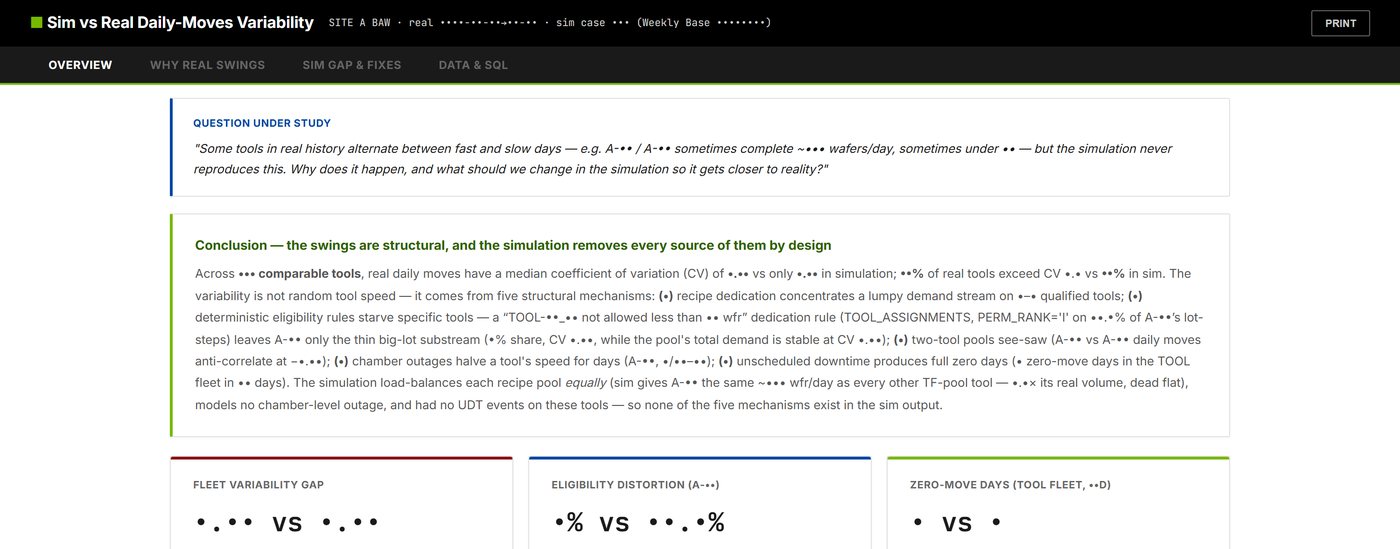
REAL VS SIMULATIONThroughput matched within 9% while tool loading was inverted — retracted an earlier conclusionRedacted
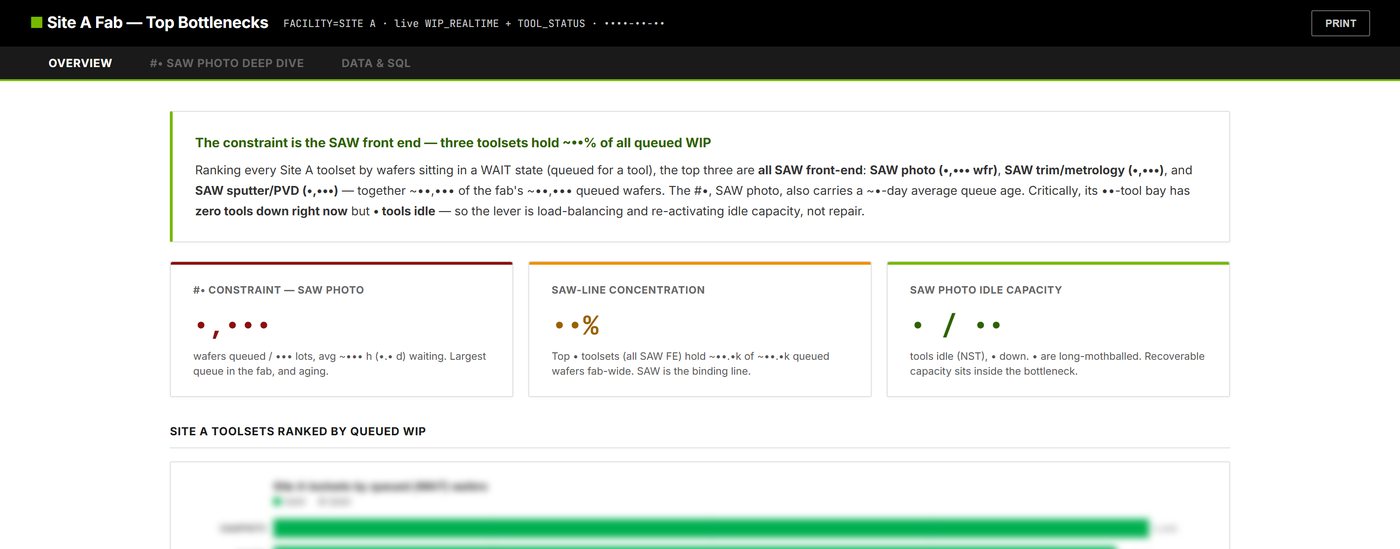
CHAMBER-LEVEL ANALYSISPer-chamber throughput and idle decomposition across an etch fleetRedacted
CROSS-AREA WIP FLOWAnimated flow player, real and simulated on one clock — structure agreed, distribution did notRedacted
DOWNTIME LOT IMPACTTracing individual lots through an outage to quantify queue-time costRedacted
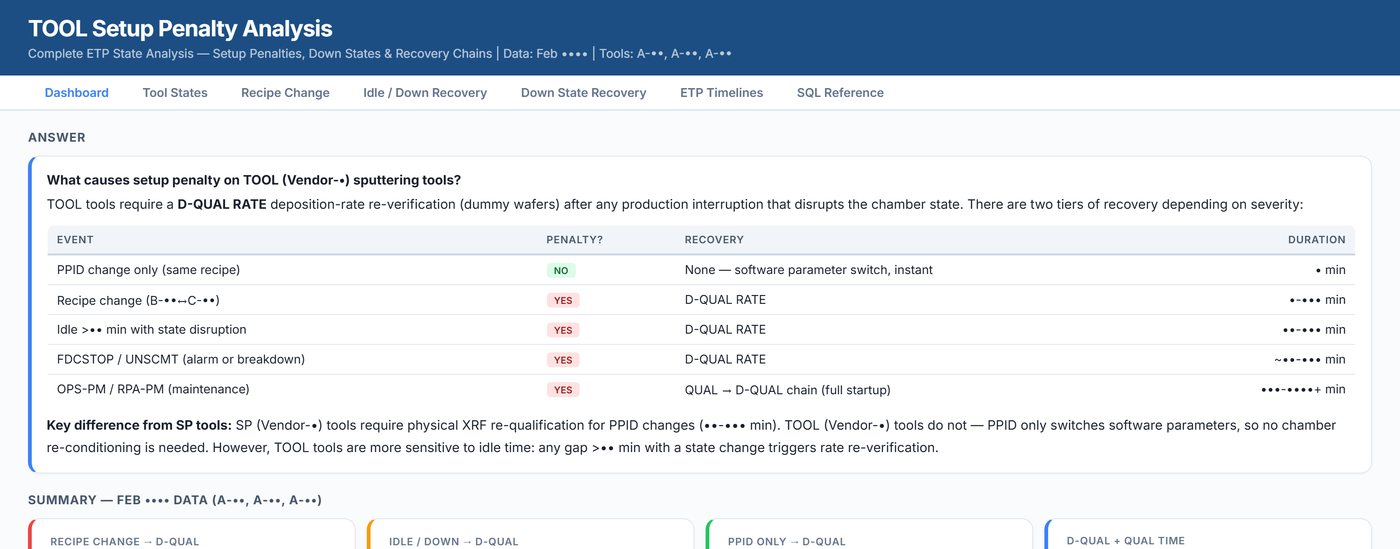
SETUP PENALTYChangeover cost by sequence, and what dispatch rules would recover
On redaction. Every screenshot above is machine-de-identified before publication.
Because these reports draw their charts on <canvas> from embedded data, blurring
the page would leave identifiers baked into the chart labels — so equipment IDs, routes, lot
numbers, site names and internal system names are substituted at the source with a consistent
pseudonym map, then re-rendered. Same tool keeps the same alias in every chart, so the analysis
still reads correctly. The audit across all 54 reports returns zero residual matches.
§03
Profile
I am a senior industrial engineer at Skyworks Solutions, where my title says
industrial engineering and my work reads as platform engineering. I own the software and data
systems behind capacity planning and fab simulation — database integration, pipeline design,
API, frontend, deployment — for wafer fabs in the United States, Japan and Singapore.
The work I care about sits where operations research meets systems engineering: discrete-event
simulation that is actually trusted because its error is measured every week; capacity models
that survive contact with a real CapEx cycle; internal tools that people open on their own
without being told to. I built a protocol server and a knowledge base so that analysis is
reproducible rather than re-derived, and I am usually the one arguing that a finding is not
finished until someone else can reproduce it.
Before this I built a fab discrete-event simulation engine from scratch as an intern, which
became the technical foundation for the company's enterprise simulation program.
Role
Senior Industrial Engineer, Skyworks Solutions
Focus
Capacity systems · simulation validation · internal platforms