![[Snipaste_2023-05-17_09-37-22 1.png]]
TextBook: Introduction to Linear Algebra
Definde $A$ is an $m\times n$ matrix
Chapter 3: Vector Spaces and Subspaces
3.1 Space of Vectors
3.1.1 Vector space 向量空间
向量空间是一个很广义的概念,并不一定指由向量张成的空间(即 $\R^2,…,\R^n,\Complex^n$),还可以是诸如:
- 零空间 $Z=0$
- 由 $2\times2$ 的矩阵张成的向量空间 $M$
- 由多项式张成的向量空间 $F$
3.2 The Nullspace of $A$: Solving $Ax=0$ and $Rx=0$
详见 week3.md
3.3 The Complete Solution to $Ax=\bf{b}$
Define the augmented matrix $[\;A\;\bf{b}\;]$ do the same elimations for $\bf{b}\to\bf{d}$ as $A\to R$ then we get $[\;R\;\bf{d}\;]$ 这两个增广矩阵的解集相同
3.3.1 One Particular Solution $Ax_p=\bf{b}$
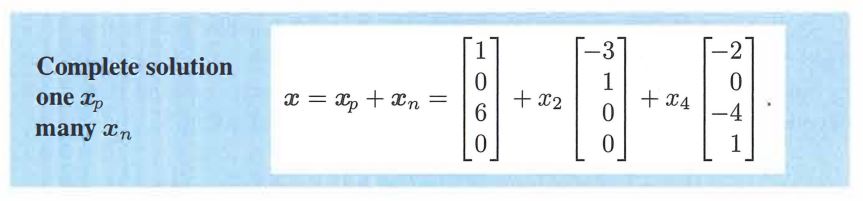
求解 $x_p$:将所有 free columns 对应的 free variables 均设为 $0$, 再求解剩下的 pivots varibales

求解 $x_n$ 的具体过程在 Chapter 3.2 中有详细的介绍,总的来说就是分别将每个 free variable 设为 $1$,其他 free varibales 设为 $0$,再求出对应的 pivots variables 的值(例如下图中一个令 $x_2=1$,另一个令 $x_4=1$)
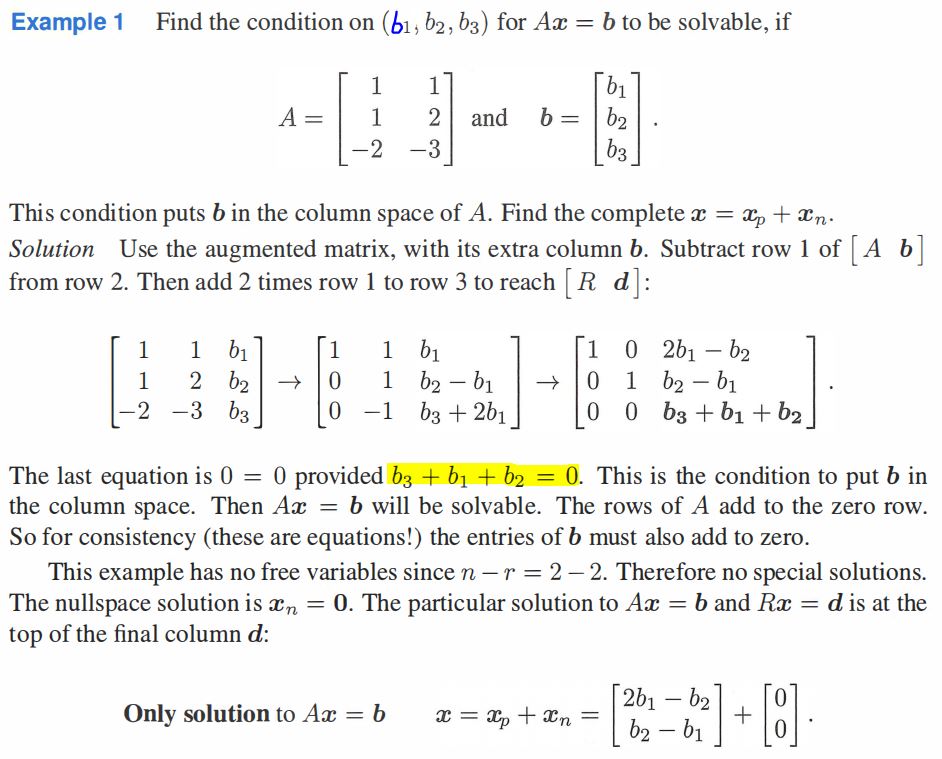

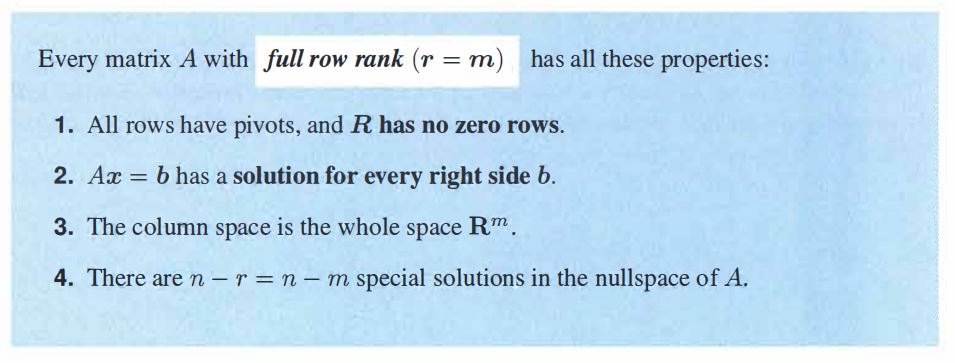 上图中的第三点和第二点其实在讲同一个东西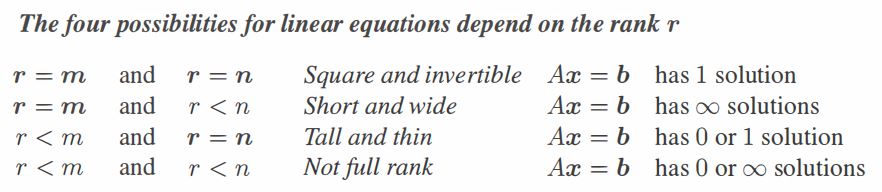

$r<m$ means there are $m-r$ zero rows $r<n$ means there are $n-r$ free columns
3.4 Independence, Basis and Dimension
3.4.1 Linear Independence
这块内容比较简单,下面仅给出一些定义
- The columns of $A$ are linearly independent when the only solution to $A\bf{x}=0$ is $\bf{x}=0$
- Similar to the sequence of vectors when they are linearly independent
- Any set of $n$ vectors in $\R^m$ must be linearly dependent if $n > m$
3.4.2 Vectors that Span a Subspace
Definition: A set of vectors span a space if their linear combinations fill the space (这些向量可以是相互独立的,也可以存在依赖关系)
Row Space

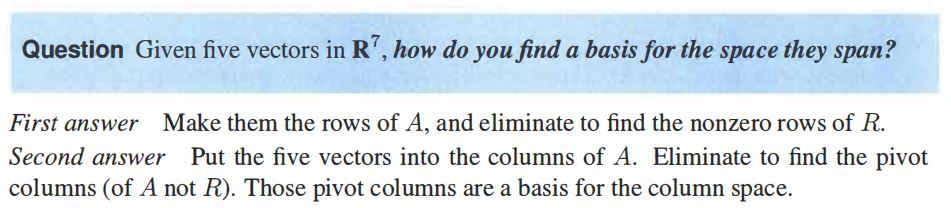
3.4.3 A Basis of a Vector Space


这里需要注意的是,
- $C(A)\neq C(R)$, $\text{dimension}(C(A))=\text{dimension}(C(R))$
- $C(A^T)=C(R^T)$(因为 $R$ 就是由 $A$ 通过行的线性组合所简化而来的)
3.4.4 Dimension of a Vector Space
Theorm 1: If $v_1, … , v_m$ and $w_1, … , w_n$ are both bases for the same vector space $S$, then $m = n$.
Proof: let assume $m < n$ Since
- $v_1,…,v_m$ are bases of $S$
- $w_1,…,w_n \in S$
we can use the linear combination of $v_1,…,v_m$ to express $w_i$, such that \([w_1,...,w_n]=[v_1,...,v_m]A_{m\times n}\)
For $m\times n$ matrix $A$, since $m < n$, there must exist $x$ satisfying $Ax=0$, then we can derive $VAx=0\to Wx=0$
Therefore, $W$ are not bases of $S$ when $m < n$. Proof done.
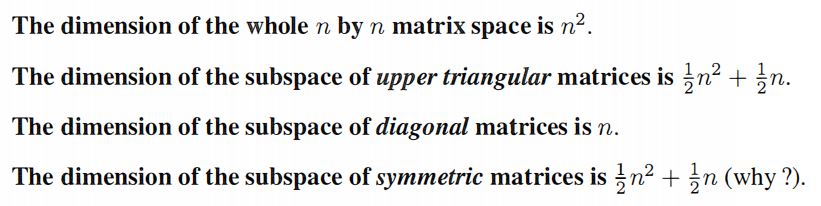
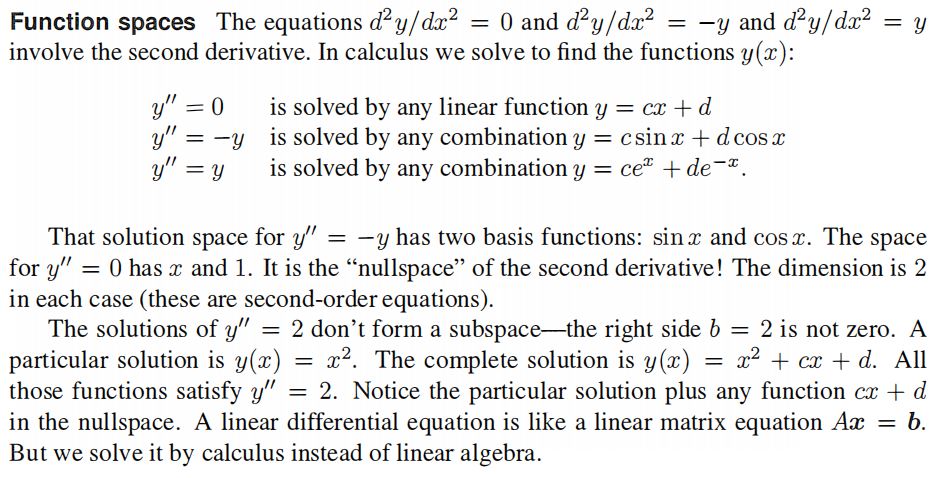
3.4.5 Bases for Matrix Spaces and Function Spaces

3.5 Dimensions of the Four Subspaces

3.5.1 The Four Subspaces for $R$
3.5.2 The Four Subspaces for $A$
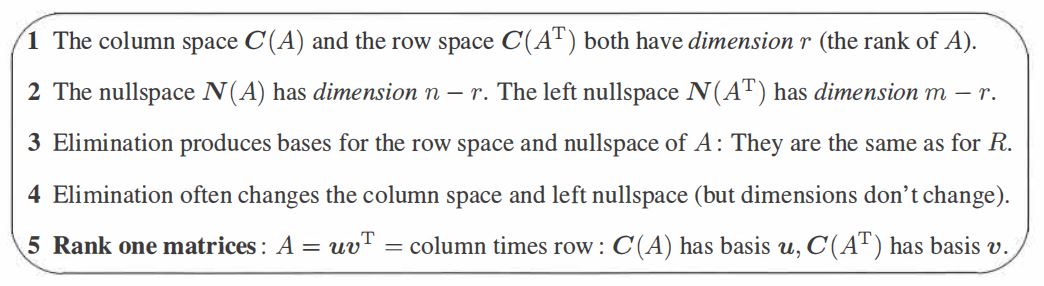
在 Section 3.4.3 中,有提到 $C(A^T)=C(R^T)$ (列空间相同),但 $C(A)\neq C(R)$ (行空间不同)。 当拓展到零空间与左零空间时,相反的,$N(A)=N(R)$ (零空间相同_,但 $N(A^T)\neq N(R^T)$ (左零空间不同)
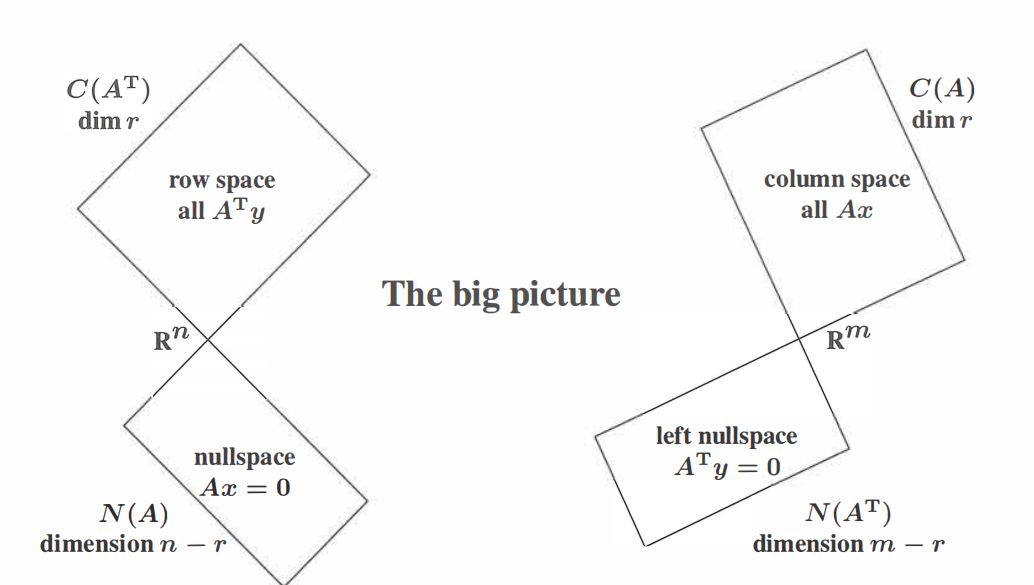
上图主要基本表达了关于四个子空间的所有重要的信息, 其中之前没有提及的是
- $N(A)\perp C(A^T)$, 即零空间与行空间正交
- $C(A)\perp N(A^T)$, 即列空间与左零空间正交
Exapmle 1: 对于 $A=[1\;2\;3]$,$m=1,n=3,r=1$
column space $C(A^T)$: dimension = $r=1$ row space $C(A)$: dimension = $r=1$ null space $N(A)$: dimension = $n-r=2$ null space $N(A^T)$: dimension = $m-r=0$,i.e. $N(A^T)=Z$
3.5.2 Rank One Matrix
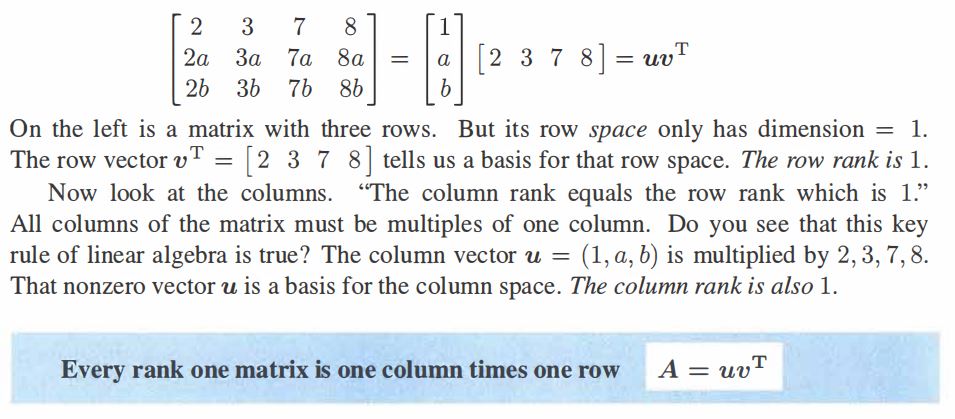 Rank Two Matrix = Rank One plus Rank One = $u_1v_1^T+u_2v_2^T$
3.A Textbook Problems 3.1 - 3.3
3.A.1
3.A.1.1 True of false
The vectors $b$ that are not in the column space $C(A)$ form a subspace
False. There is no zero space. Addition rule sometimes do not satisfy
3.A.2
3.A.2.1
Construct a matrix for which $N(A)=$ all combinations of $(2,2,1,0)$ and $(3,1,0,1)$
Ans: let $B=\begin{bmatrix} 2 & 2 & 1 & 0
3 & 1 & 0 & 1 \end{bmatrix}$ then we get $AB^T=0$
therefore $BA^T=0$, so columns of $A^T$ are in $N(B)$. 因此如果 $x_1,x_2$ 为 $Bx=0$ 的 special solutions, 那么 $A$ can be $\begin{bmatrix} x_1^T
x_2^T \end{bmatrix}$
Chapter 4: Orthogonality
4.1 Orthogonality of the Four Subspaces
Def 1: Orthogonal subspaces
$v^T w=0$ for all $v\in V$ and $w\in W$
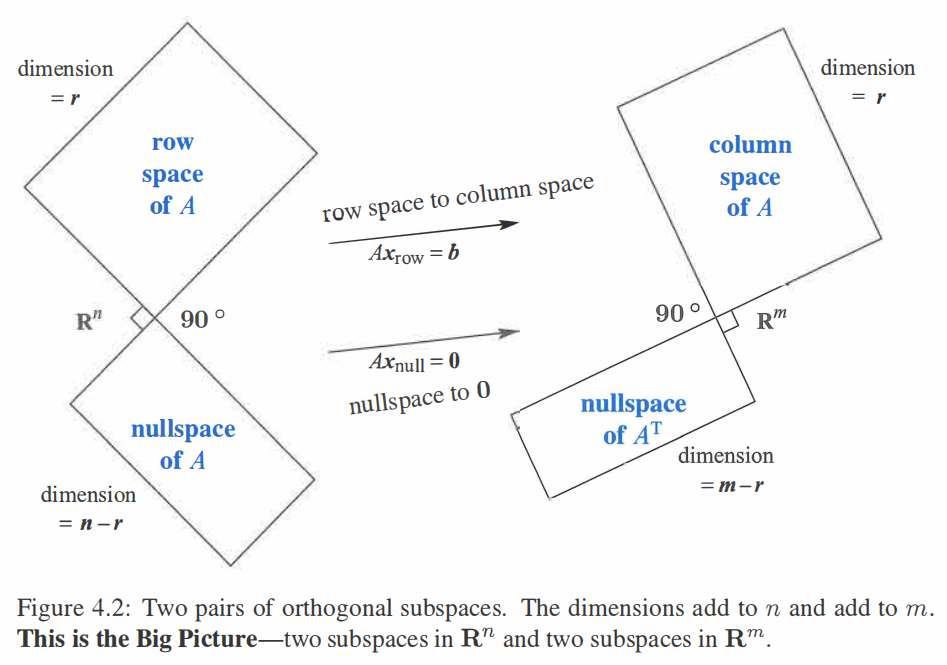
The nullspace $N(A)$ and the row space $C(A^T)$ are orthogonal subspaces of $\R^n$. Since $Ax = 0$, that is, every vector $x$ in $N(A)$ is perpendicular to every row of $A$.
更具体的证明: Let $A^Ty$ be the combination of the basis of $C(A^T)$, $x\in N(A)$, then \(x\cdot A^Ty=x^T(A^Ty)=(Ax)^Ty=0^Ty=0\)
The left nullspace $N(A^T)$ and the column space $C(A)$ are orthogonal subspaces of $\R^m$. 证明同上
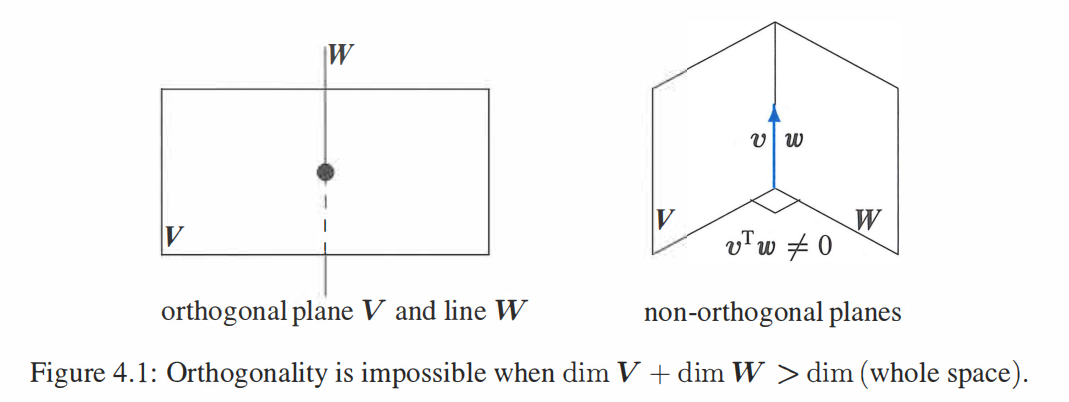
两个正交空间的交点为零空间 (在二维或者三维空间中的体现就是点 $(0,0)$ 或 $(0,0,0)$)
4.1.1 Orthogonal Complements
Def 2: Orthogonal complement
The orthogonal complement of a subspace $V$ contains every vector that is perpendicular to $V$. This orthogonal subspace is denoted by $V^\perp$
- Fact 2.1 若子空间 $A,B\subset \R^n$ 互为正交补,即 $A^\perp=B,B^\perp=A$ 那么 $\text{dim}(A)+\text{dim}(B)=n$
例如,$N(A),C(A^T)$ 正交且互为正交补 $(n-r)+r=n$;但是 $\R^3$ 中的两正交线条不能叫互为正交补 $1+1<3$
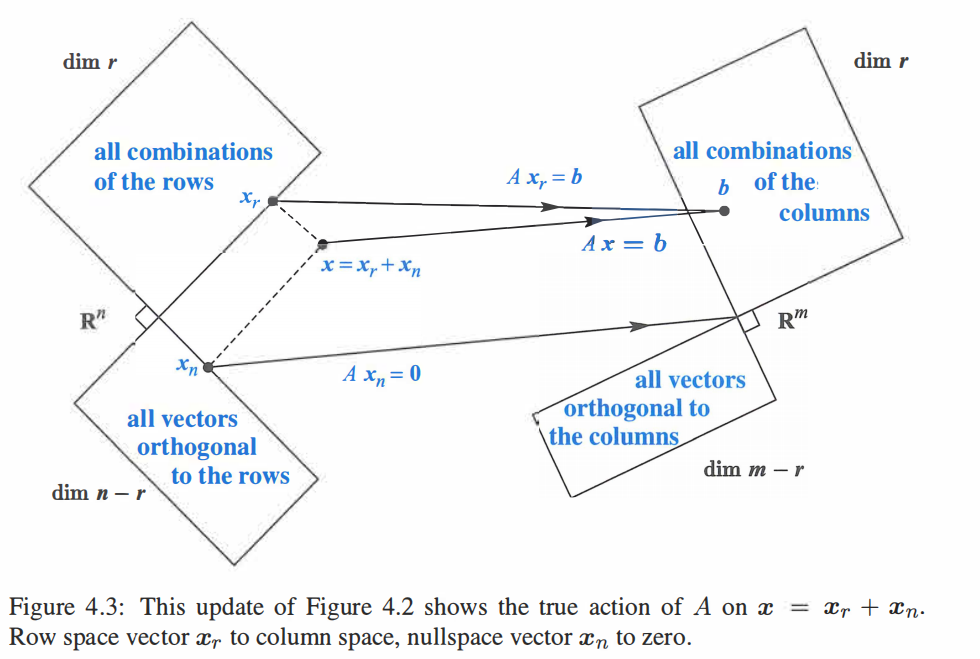
这里的 $x$ 之所以能被写成 $x_r+x_n$,是因为 $C(A^T),N(A)$ 在 $\mathbb{R}$ 中互为正交补
4.1.2 Combining Bases from Subspaces
令子空间 $A,B\subset S$,若 $A,B$ 正交,那么可以说子空间 $A, B$ 构成了整个空间 $S$,例如
- For $A_{m\times n}$, if $C(A^T)\perp N(A)$, then every $x\in\R^n$ can be split into $x_r+x_n$
- 对于列空间和左零空间同理
4.2 Projections
Define
- initial vector $b$
- projection $p$
- projection matrix $P$
通过计算 $A^2$ 是否等于 $A$ 来判断该矩阵是否可以是 projection matrix
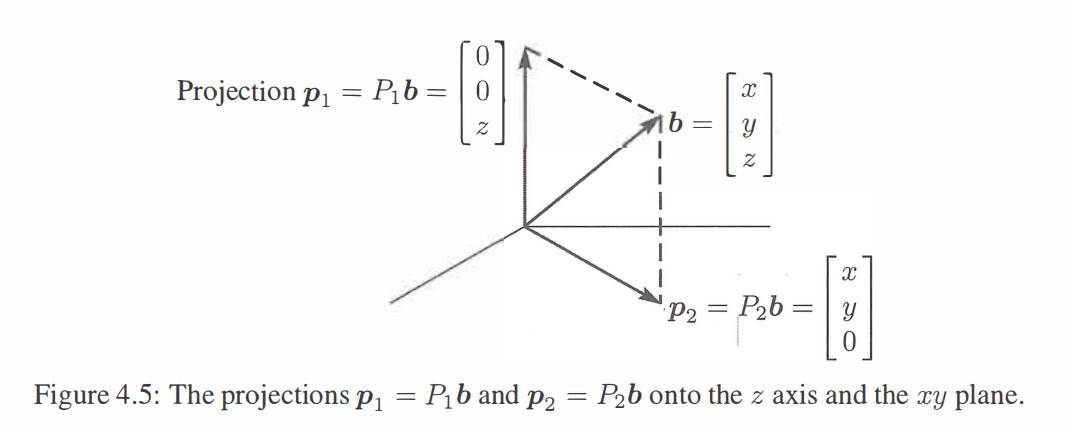
如图,若 $p_1$ 是 $b$ 经 $P_1$ 在 $S$ 上的投影,而 $p_2$ 是 $b$ 经 $P_2$ 在 $S^\perp$ 上的投影,可得
- $b=p_1+p_2$
- $P_1+P_2=I$
4.2.1 Projection Onto a Line
Define
- Let $a$ denote a line, $A$ denote a plane
- error $e=b-p$
- coefficient $\hat{x}$ that satisfies $p=\hat{x}a$ or $p=A\hat{x}$
计算 $\hat{x}$
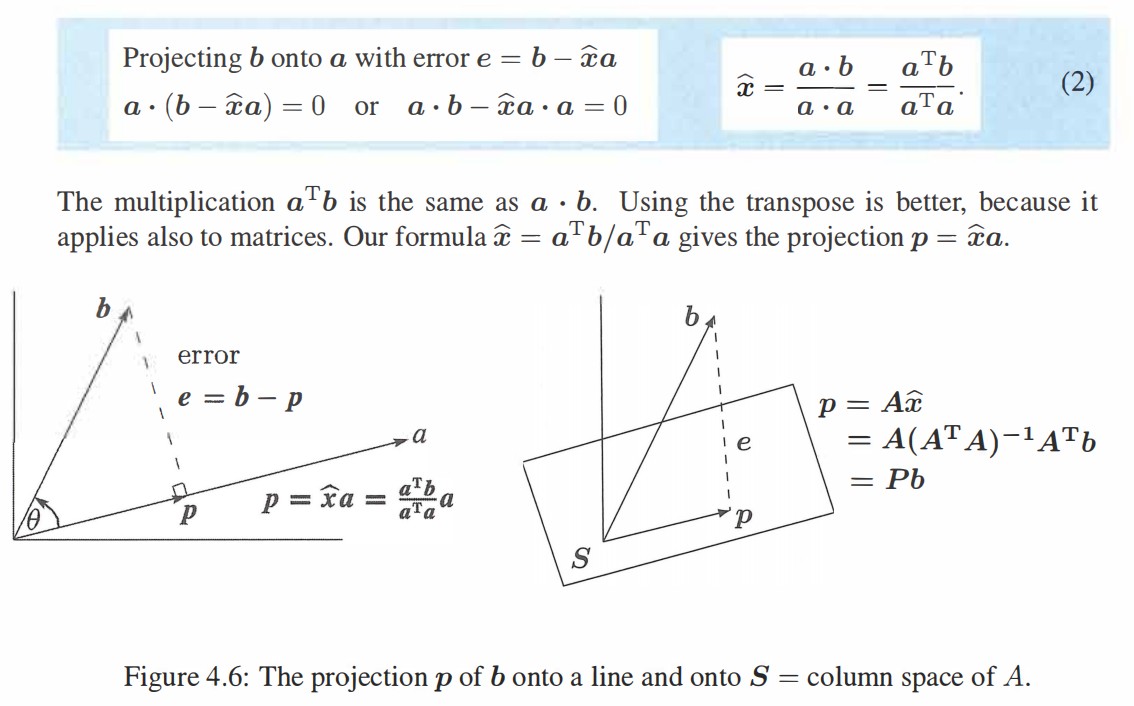
这里的 $\hat{x}$ 为系数,类似于 Math415 Week-05 中 L8.2.1 的 $c,d$, 因此当映射空间的维度为 $1$ 时, $p=\hat{x}a=a\hat{x}$。再由 $p=Pb$ 可得(下面两式其实是一样的) \(P_{line}=\frac{aa^T}{a^Ta}, P_{plane}=A(A^TA)^{-1}A^T\)
Fact 1 Projection a second time doesn’t change any thing: $P=P^2=P^n$
Fact 2 When $P$ projects onto one subspace, $I - P$ projects onto the perpendicular subspace.
4.2.2 Projection Onto a Subspace
进一步的,对于被投影的子空间 $A_{m\times n}$,以及 $p_{m\times 1},b_{m\times 1},P_{m\times m}$,可得关于 $\hat{x},p,P$ 的表达式 (前提是 $A$ 列满秩,即 $r=n$)
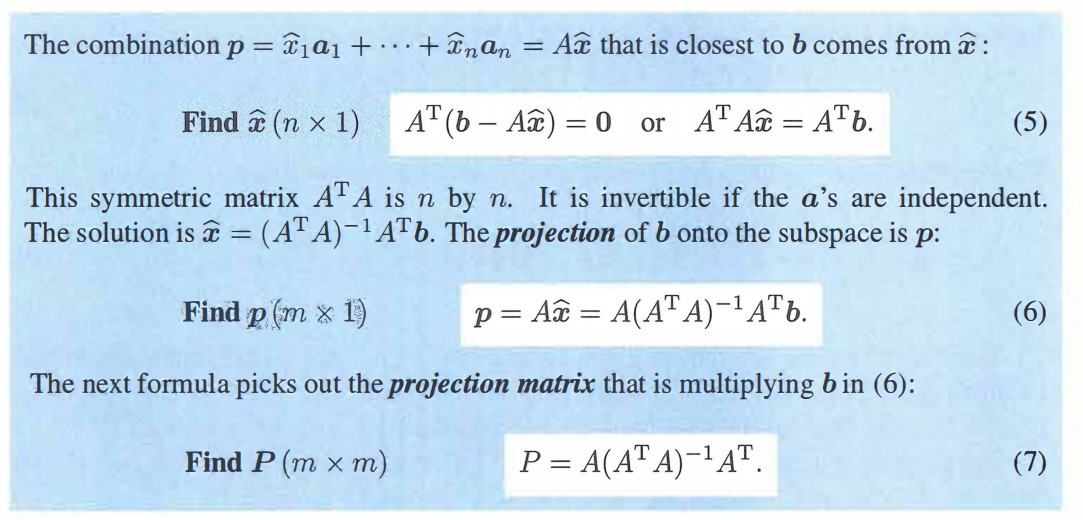
Warning 对于 $P$ 的表达式,不能把 $(A^TA)^{-1}$ 拆成 $A^{-1}A^{-T}$,因为 $A$ 本身就是不可逆的(如果能拆的话,就会得出 $P=I$,离谱)
Fact 
- Proof \(A^TAx=0\to x^TA^TAx=0\to(Ax)^T(Ax)=0\to Ax=0\) (反推也成立) 因此 $A^TAx=0\iff Ax=0$,即如果 $N(A)=0$ 那么 $N(A^TA)=0$,又因为 $A^TA$ 为方阵,因此行列均满秩,因此可逆 (同时 $A^TA$ 也是一个对称矩阵)
4.3 Least Squares Approximations
对于 $e=b-p=b-Ax$,为了 minimize error,即使得 $e=0$,要想找到 $x$,那么 $Ax=b$ 必须有解。但是对于大部分情况而言,$Ax=b$ 无解(通常由于表达式多于未知数),此时 $|e|>0$

4.3.1 Minimizing the Error
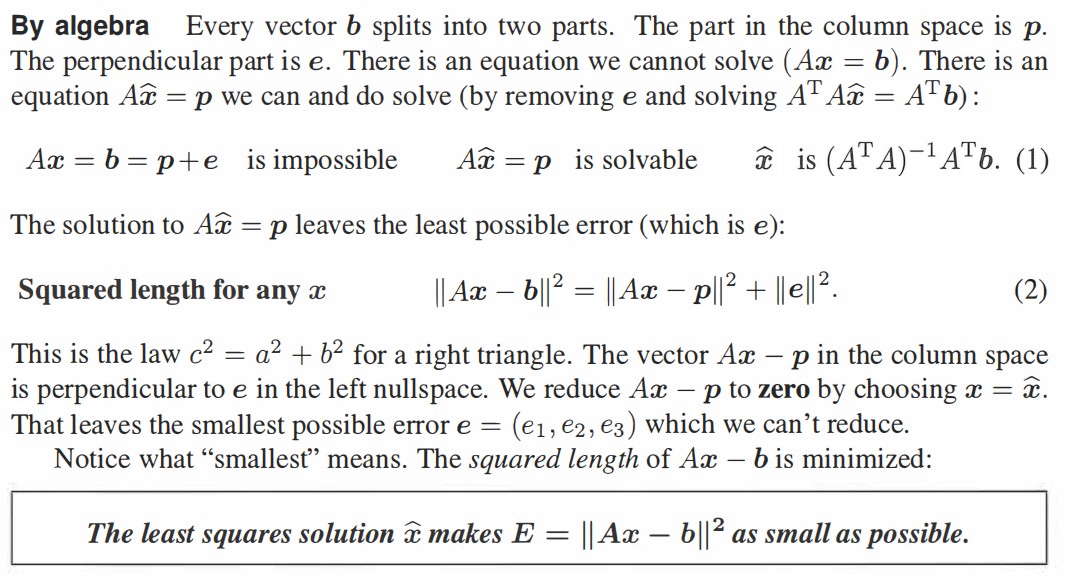
以上是从代数的角度来 minimize $e$,如果换成从 calculus 的角度,就相当于求解当偏微分等于 $0$ 时 $x$ 的值,结果是相同的 (见 Math415 Week-07 L12.1)
The partial derivatives of $\vert\vert Ax-b\vert\vert^2$ are zero when $A^TA\hat{x}=A^Tb$
4.3.2 The Big Picture for Least Squares
当 $Ax=b$ 无解时,big picture 将变为以下形式 为了计算方便,假使 $A$ 的列满秩,因此下图中 $N(A)$ 只有一个点
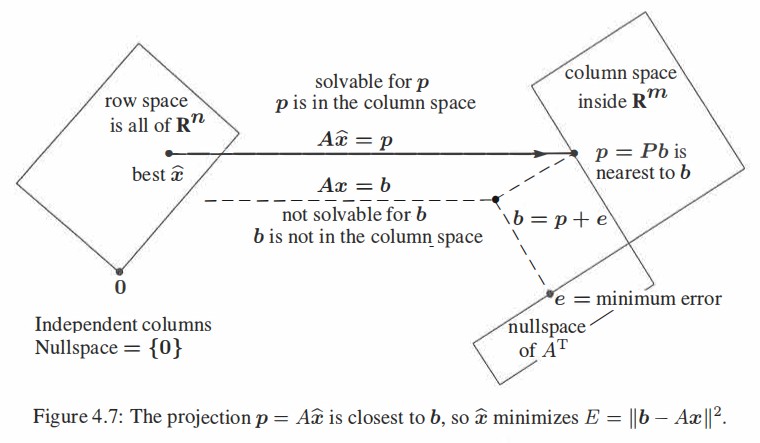
4.3.3 Fitting a Straight Line
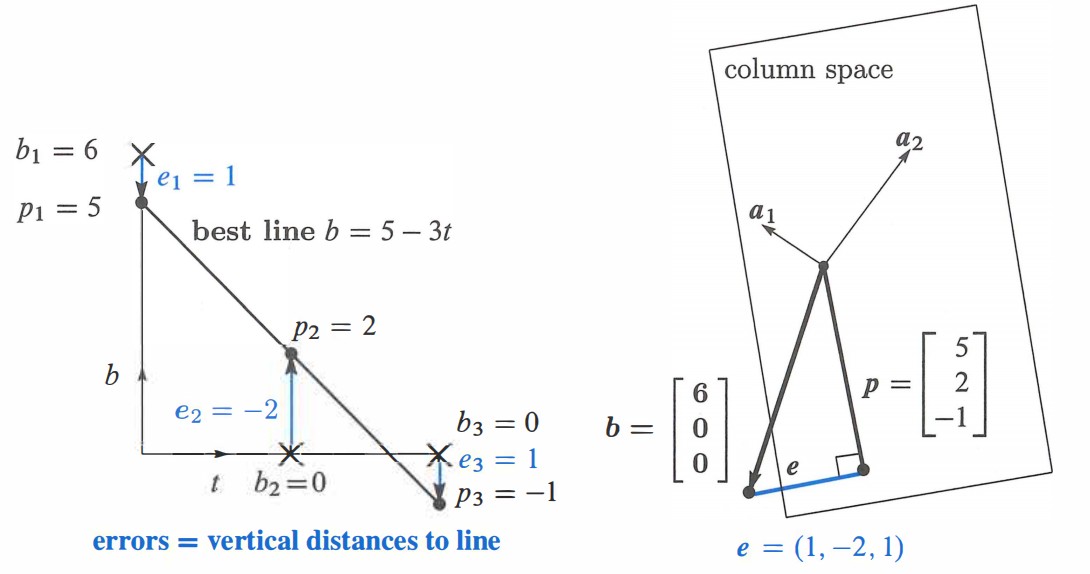
Example 1 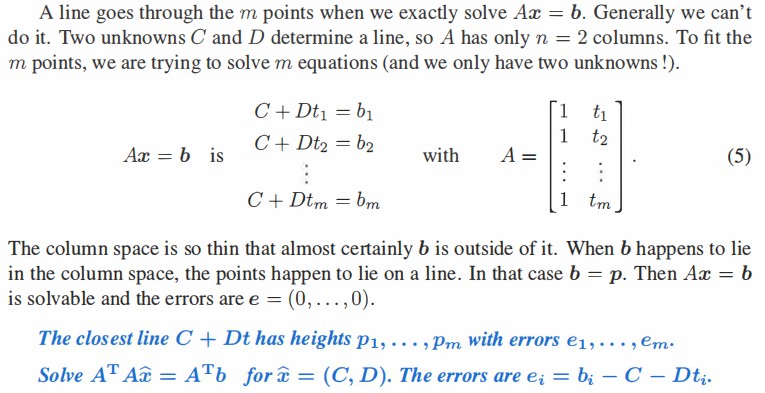
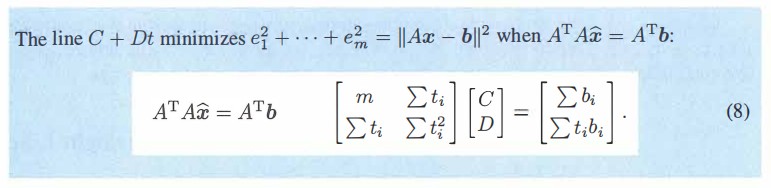
Example 2 这个例子说明当 $A$ 的列向量 orthogonal 时,$A^TA$ 会呈现出良好的对角矩阵的形式 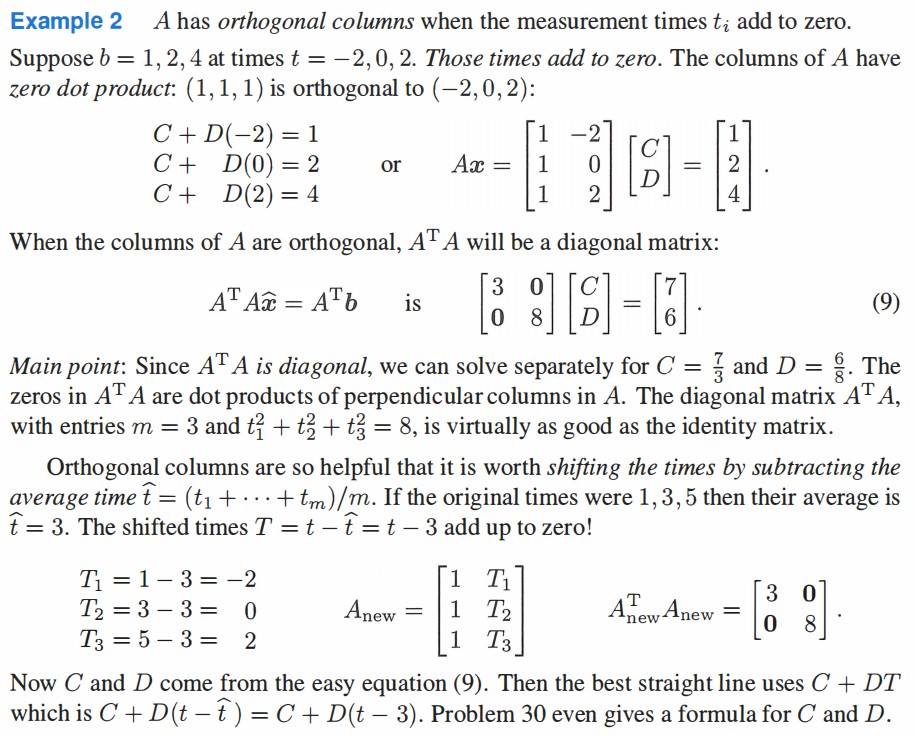
4.3.4 Dependent Columns in $A$: What is $\hat{x}$?
略
4.3.5 Fitting by a Parabola
没看,感觉和 ppt 的内容没啥关系
4.4 Orthonormal Bases and Gram-Schmidt
Def 1: Orthonormal
The vectors $\bf{q}_1,…,\bf{q}_n$ are orthonormal if \(\bf{q}_i^T\bf{q}_j=\begin{cases} 0 &\text{when } i\neq j\text{ (orthogonal vectors)} \\ 1 &\text{when } i=j\text{ (unit vectors: }\|\bf{q}_i\|=1) \end{cases}\) A matrix with orthonormal columns is assigned the special letter $\bf{Q}$.
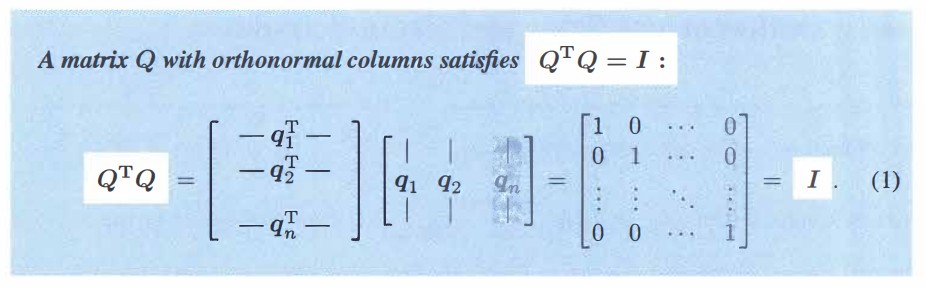
由于 $Q^{-1}Q=I$,因 $Q^{-1}=Q^T$ (这些是当 $Q$ 为方阵的时候才满足的性质,再比如 $QQ^T=Q^TQ=I$)
Def 2: Orthogonal matrix 正交矩阵
满足 transpose = inverse 的矩阵,即 $Q^{-1}=Q^T$,称作正交矩阵 (正交矩阵一定是方阵)
例如,Rotation matrix: $\begin{bmatrix} \cos(\theta) & -\sin(\theta)
\sin(\theta) & \cos(\theta) \end{bmatrix}$, Permutation matrix: $\begin{bmatrix} 0 & 1 & 0
0 & 0 & 1
1 & 0 & 0 \end{bmatrix}$
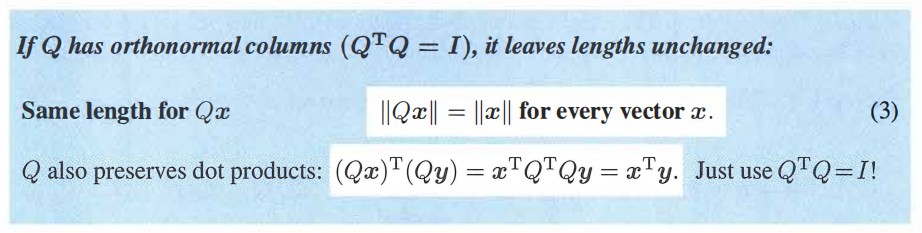
4.4.1 Projections Using Orthonormal Bases: $Q$ Replaces $A$
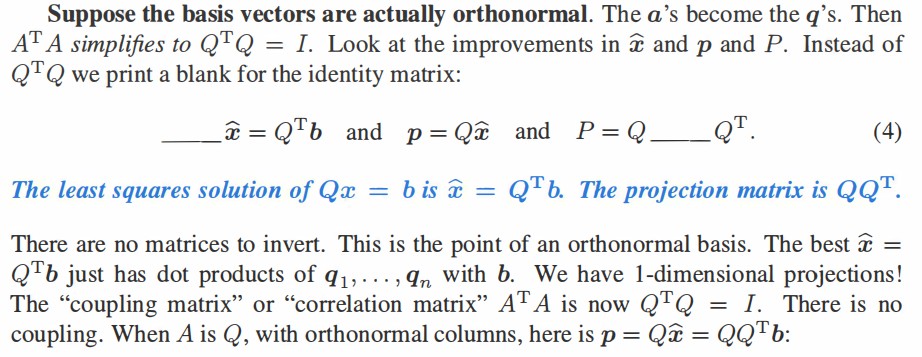
如果 $A$ 本身就是一个 orthonormal matrix,令 $Q=A$,那么就满足 \(p=Q\hat{x}=QQ^Tb\) 更进一步,如果 $Q$ 是一个方阵,那么 $Q^T=Q^{-1}$,此时有 \(p=b,P=I\)
4.4.2 The Gram-Schmidt Process
4.4.3 The Factorization $A=QR$

then from $A^TA\hat{x}=A^Tb$, we get

Chapter 06: Eigenvalues and Eigenvectors
6.1 Introduction to Eigenvalues
Def 1: Eigenvector, Eigenvalue
矩阵 $A$ 的特征向量 $x$ 指的是那些经过线性变换 $Ax$ 之后方向不变,仅发生伸缩或反向变换的向量 \(Ax=\lambda x\)
其中特征向量 $\lambda$ 体现了 $x$ 发生的伸缩、取反变换
Corollary 1: \(A^nx=\lambda^nx,A^{-1}x=\lambda^{-1}x\)
Def 2: Characteristic polynomial
The characteristic polynomial of $A_{n\times n}$ has degree $n$ \(\delta_A(\lambda)=\det(A-\lambda I)\)
$\det(A-\lambda I)=0$ is called characteristic equation, it has $n$ roots
Def 3: Trace 矩阵的迹
\(\text{tr}(A)=\sum_{k=1}^n a_{kk}=\sum_{k=1}^n \lambda_k\)
About Eigenvlues, Eigenvector, rank and trace
- $n$ 阶矩阵有 $n$ 个特征值
- 对称矩阵的秩 = 非零特征值的个数
6.2 Diagonalizing a Matrix
Def 1: Diagonalizable matrix 可对角化矩阵
$n$ independent eigenvectors (normalized) in $X$ diagonalize $A$ \(A=X\Lambda X^{-1}\)
判断一个矩阵是否为可对角化矩阵主要有以下几个途径
- $n$ 个不同的特征值/ $n$ 个线性无关的特征向量
- 代数重数 = 几何重数
- 实对称矩阵
当存在相同的特征根时, $A$ might have too few independent eigenvectors. Then $X^{-1}$ fails.
6.3 Systems of Differential Equations
(已看完)
6.3.1 Solution of $du/dt = Au$
这部分可以用一个例题概括, 见 Midterm 2 Review D7.2
6.3.2 Second Order Equations
这部分大概率不会考到, 如果考到最多也是长这样的 Midterm 3 Review D7.2
6.3.3 Difference Equations (optional)
不考
6.3.4 Stability of 2 by 2 Matrices
不考 (不过挺有意思的, 有时间可以看看)
6.3.5 The Exponential of a Matrix
Def 1 Matrix exponential $e^{At}$
\(\begin{aligned} e^x&= 1 + x + \frac{1}{2}x^2+\frac{1}{6}x^3+...=\sum_{k=0}^\infty{\frac{x^k}{k!}}\\ e^{At}&=I+At+\frac{1}{2}(At)^2+...=\sum\frac{(At)^k}{k!} \end{aligned}\)
The eigenvalues of $e^{At}$ are $e^{\lambda t}$, since $(I+At+\frac{1}{2}(At)^2+…)\pmb{x}=(I+\lambda t+\frac{1}{2}(\lambda t)^2+…)\pmb{x}$
Lemma 1: If $A$ is diagonalized, then $e^{At}$ is also diagonalized \(A=X\Lambda X^{-1}\to e^{At}=X[I+\Lambda t+\frac{1}{2}(\Lambda t)^2+...]X^{-1}\)
therefore \(e^{At}=Xe^{\Lambda t}X^{-1}\)
可以利用这个性质来求解 Chapter 6.3.1 中的 $u(t)=e^{At}u(0)$
这一小节的其他部分应该也不会考, 不过可以看看下面这个 example, 它提供了一种求解二阶微分方程的新方法, 很有意思 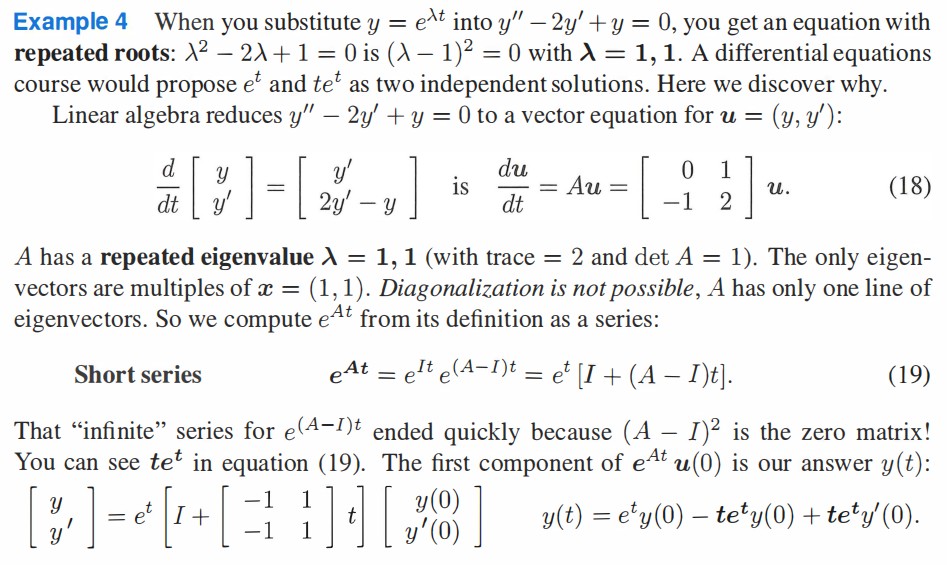
6.4 Symmetric Matrices
6.4.1 Main
Def 1: Symmetric diagonalization
\(S=Q\Lambda Q^{-1}=Q\Lambda Q^T \text{ with } Q^{-1}=Q^T\)
$Q$ is orthonormal.
Proof: Since symmetric matrix $S$ is diagonalizable, then $S=X\Lambda X^{-1}$, plus that $S^T=X^{-T}\Lambda X^T$ and $S^T=S$, we have \(X^T=X^{-1}\to X\text{ orthonormal, denoted by }Q\)
Theorem 1: Real Eigenvalues All the eigenvalues of a real symmetric matrix are real.
Theorem 2: Orthogonal Eigenvectors Eigenvectors of a real symmetric matrix (when they correspond to different $\lambda$’s) are always perpendicular.
Theorem 3: For every symmetric matrices, we have \(S=Q\Lambda Q^T=\lambda_1q_1q_1^T+...+\lambda_nq_nq_n^T\)
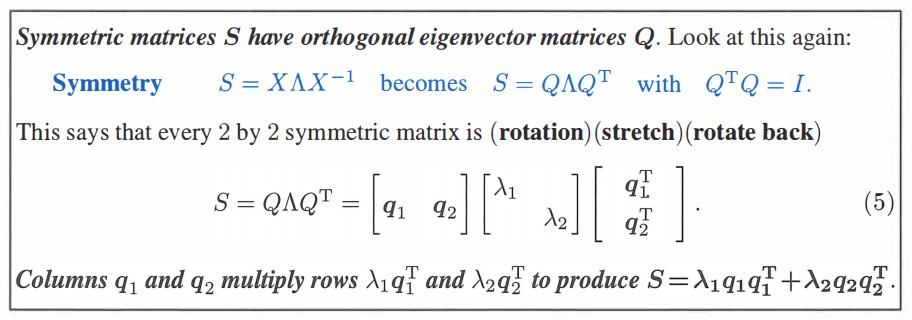
注: 上图中 (rotation)(stretch)(rotate back) 中的 (stretch) 会改变向量的方向, 并不是传统意义上的拉伸 (不改变方向), 譬如 \(\Lambda=\begin{bmatrix} 3 & 0\\ 0 & 1 \end{bmatrix}\to \Lambda\begin{pmatrix} x_1 \\ x_2 \end{pmatrix}=\begin{pmatrix} 3x_1 \\ x_2 \end{pmatrix}\)
6.4.2 Complex Eigenvalues of Real Matrices
后面个人感觉至少对于 midterm 3 不太重要, 等 final 再看
Chapter 09-10 FFT and Graph
9.3 The Fast Fourier Transform (FFT)
For the equation $z^n=1$, the solutions $z$ are the “$n$th roots of unity”, which are evenly spaced points around the unit circle in the complex plane. For example, when $n=8,z^8=1$ 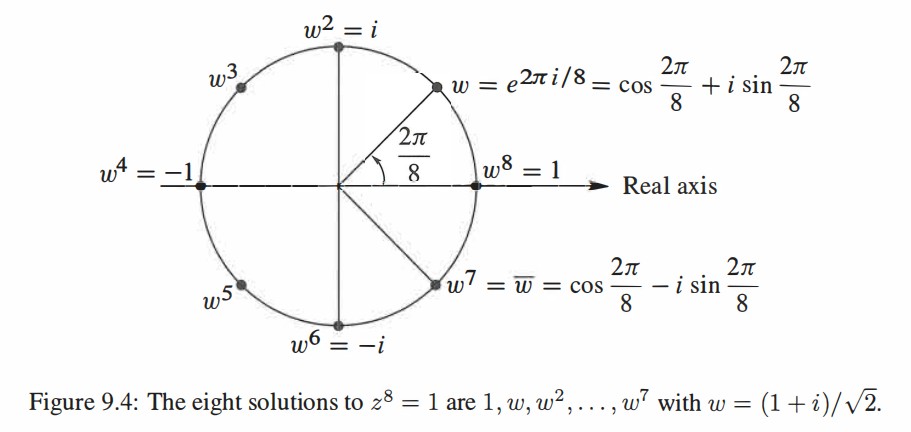
Def 1: Fourier matrix
Fourier matrix with $n=4,w=e^{2\pi i/4}=i$ \(F=\begin{bmatrix} 1 & 1 & 1 & 1 \\ 1 & w & w^2 & w^3 \\ 1 & w^2 & w^4 & w^6 \\ 1 & w^3 & w^6 & w^9 \\ \end{bmatrix}=\begin{bmatrix} 1 & 1 & 1 & 1 \\ 1 & i & i^2 & i^3 \\ 1 & i^2 & i^4 & i^6 \\ 1 & i^3 & i^6 & i^9 \\ \end{bmatrix}\)
Fact 1: $\frac{1}{\sqrt n}F$ is a unitary matrix, since \((\frac{1}{\sqrt n}F^H)(\frac{1}{\sqrt n}F)=I\)
Fact 2: From $F^HF=nI$, we have \(F^{-1}=\frac{1}{n}F^H=\frac{1}{n}\overline F\)
Def 2: Fourier series
Fourier series with $n=4$, we have \(y_j=\sum_{k=0}^3 c_ke^{ikx}, x=2\pi j/4\)
\[\begin{bmatrix} y_0 \\ y_1 \\ y_2 \\ y_3 \\ \end{bmatrix}=Fc=\begin{bmatrix} 1 & 1 & 1 & 1 \\ 1 & w & w^2 & w^3 \\ 1 & w^2 & w^4 & w^6 \\ 1 & w^3 & w^6 & w^9 \\ \end{bmatrix}\begin{bmatrix} c_0 \\ c_1 \\ c_2 \\ c_3 \\ \end{bmatrix}\]
10.1 Graphs and Networks
10.1.1 The Incidence Matrix
The incidence matrix of a graph,即图的关联矩阵,能够表示图中节点之间是如何连接的
对于一个 $m\times n$ 的关联矩阵 $A$
- $n$ 列表示有 $n$ 个节点
- $m$ 行表示有 $m$ 条连接线
- $\text{rank}(A)=n-1$ \(a_{ij}=\begin{cases} -1 &\text{then 节点 j 为连接线 i 的起点}\\ 0 &\text{then 节点 j 与连接线 i 无关}\\ 1 &\text{then 节点 j 为连接线 i 的终点}\\ \end{cases}\)
例如 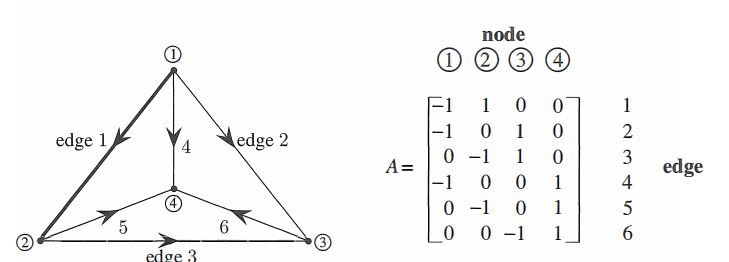
$m,n$ 之间的关系
- $m_{max}=\frac{1}{2}n(n-1)$
- $m_{min}=n-1$
Elimination reduce any graph to a tree
Rows are dependent when edges form a loop. Independent rows come from trees.
Document Information
- Author: Zhekai Li
- Link: https://zhekaili.github.io/0000/12/31/LA-TextBook-Introduction-to-Linear-Algebra/
- Copyright: 自由转载-非商用-非衍生-保持署名(创意共享3.0许可证)