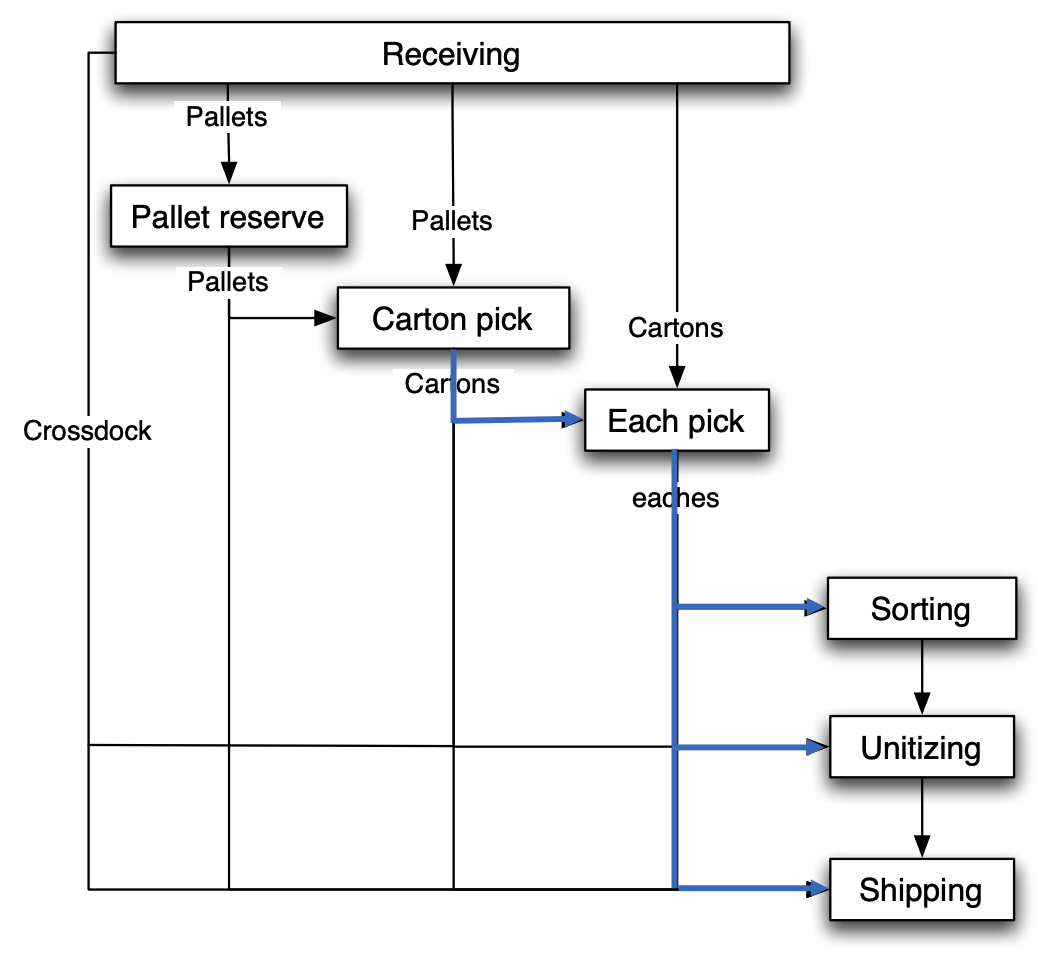
Layout decisions when designing piece(each) forward pick area
- How much of each SKU should be stored in forward pick area 3 stocking strategies
- Which SKUs to store forward? Ranking the SKUs by bang-for-buck
- How large should the forward pick area be?
Easy extensions:
- Product families
- Multiple forward areas
1. How much forward space should a SKU get?
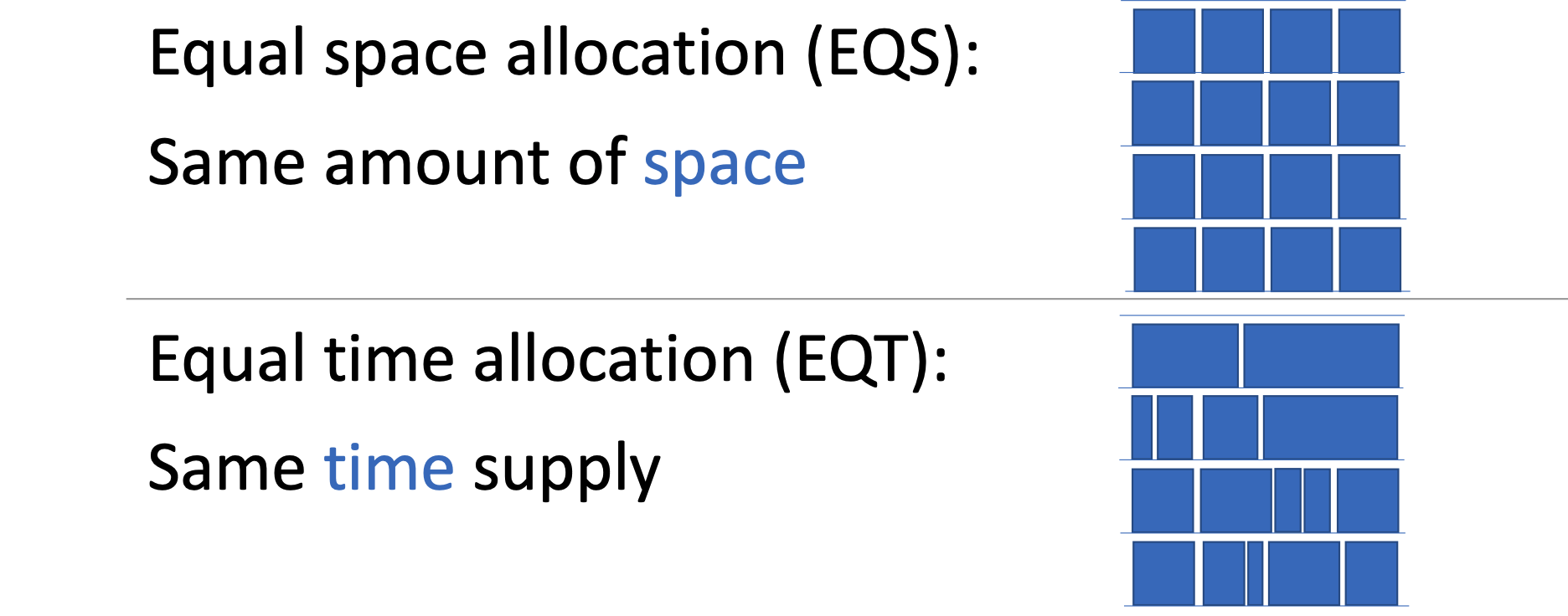
1.1 Common stocking strategies: EQS vs. EQT
1.2 Obj: Minimize Laybor Costs
- Picking time: Picking from forward area is more efficient, most of the time
- Restocking time: Number of restocks * restocking cost per restock
Denote estimated number of retocks (approximated restocking frequency): \(\frac{f_i}{v_i} = \frac{\text{flow in cubic-ft/yr}}{\text{volume stored in forward-pick area}}\)
Why say $f_i/v_i$ is an estimation/approximatiom?
- Ignores the need to safety stock $\to$ underestimate restock frequency
- Ignores possible batching in restocking when an order line for SKU_i > $v_i\to$ overestimates restock frequency
1.3 Fraction of space allocated to each SKU
If $n$ SKUs in forward area, each with flow $f_i$, suppose the total space is normalized to be $V=1$
- EQS: $v_i=1/n$
- EQT: we want $f_i/v_i$ identical for all SKUs \(v_i=\frac{f_i}{C}=\frac{f_i}{\sum^n_{j=1}f_j}\)
1.4 Number of restocks
EQS
\(\frac{f_i}{v_i}=\frac{f_i}{1/n}=nf_i\)
- Total restocks across all $n$ SKUs $=n\sum_{j=1}^nf_j$
- Fraction of restocks to SKU_i $=f_i/\sum_jf_j$
EQT
(number of restocks for every SKU is identical) \(\frac{f_i}{v_i}=\frac{f_i}{f_i/\sum f_j}=\sum_{j=1}^n f_j\)
- Total restocks across all $n$ SKUs $=n\sum_{j=1}^nf_j$
- Fraction of restocks to SKU_i $=1/n$
到这里不难发现,对于 EQS vs. EQT
- section 1.3 中的 fraction of space allocated 和这里的 fraction of restocks 的公式正好相互对调
- 两种方式的 total restockes 一样 $\to$ same amount of work!
1.5 Optimal space allocation strategy
If $n$ SKUs in forward area, each with flow $f_i$, suppose the total space is normalized to be $V=1$
\[\min\sum_{i=1}^n \frac{f_i}{v_i}\]where, $\sum_{i=1}^n v_i\leq 1$, $v_i\geq 0$
\[\boxed{v^*_i=\frac{\sqrt{f_i}}{\sum^n_{j=1}\sqrt{f_j}}}\]- Restocks of SKU_i $=\sqrt{f_i}\sum^n_{j=1}\sqrt{f_j}$
- Total restocks across all $n$ SKUs $=(\sum_{j=1}^n\sqrt{f_j})^2$
- Fraction of restocks to SKU_i $=\sqrt{f_i}/\sum\sqrt{f_j}$
Note that here fraction of restocks is equal to location allocated $v_i$
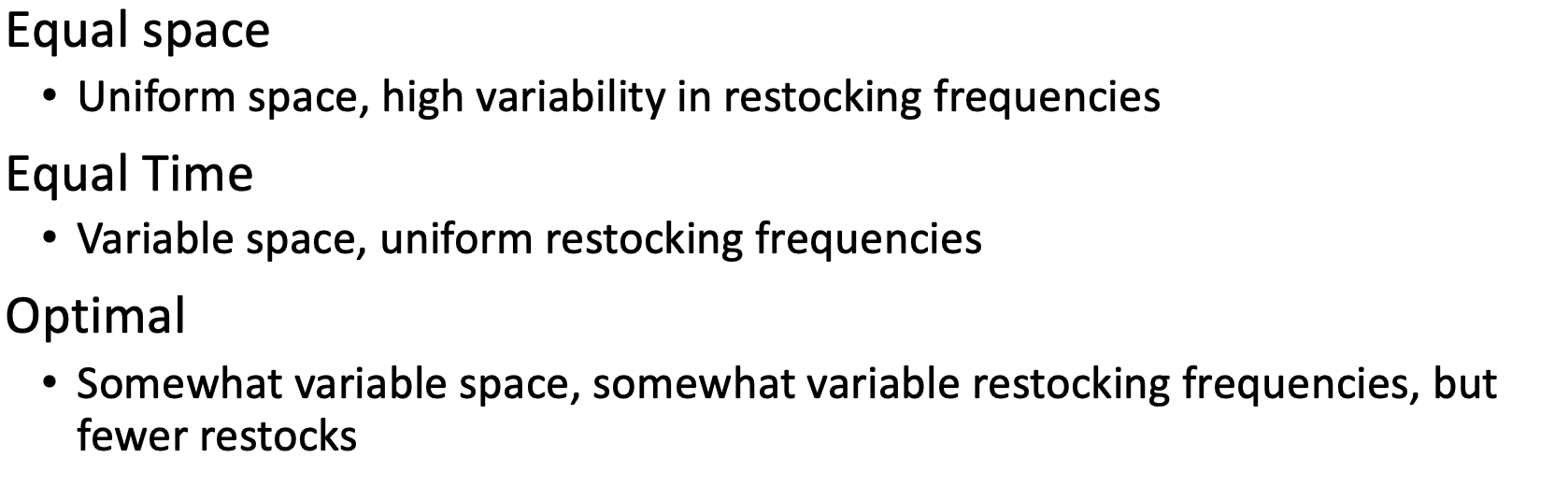
1.6 Comparing EQS vs. EQT vs. OPT
1.7 Example
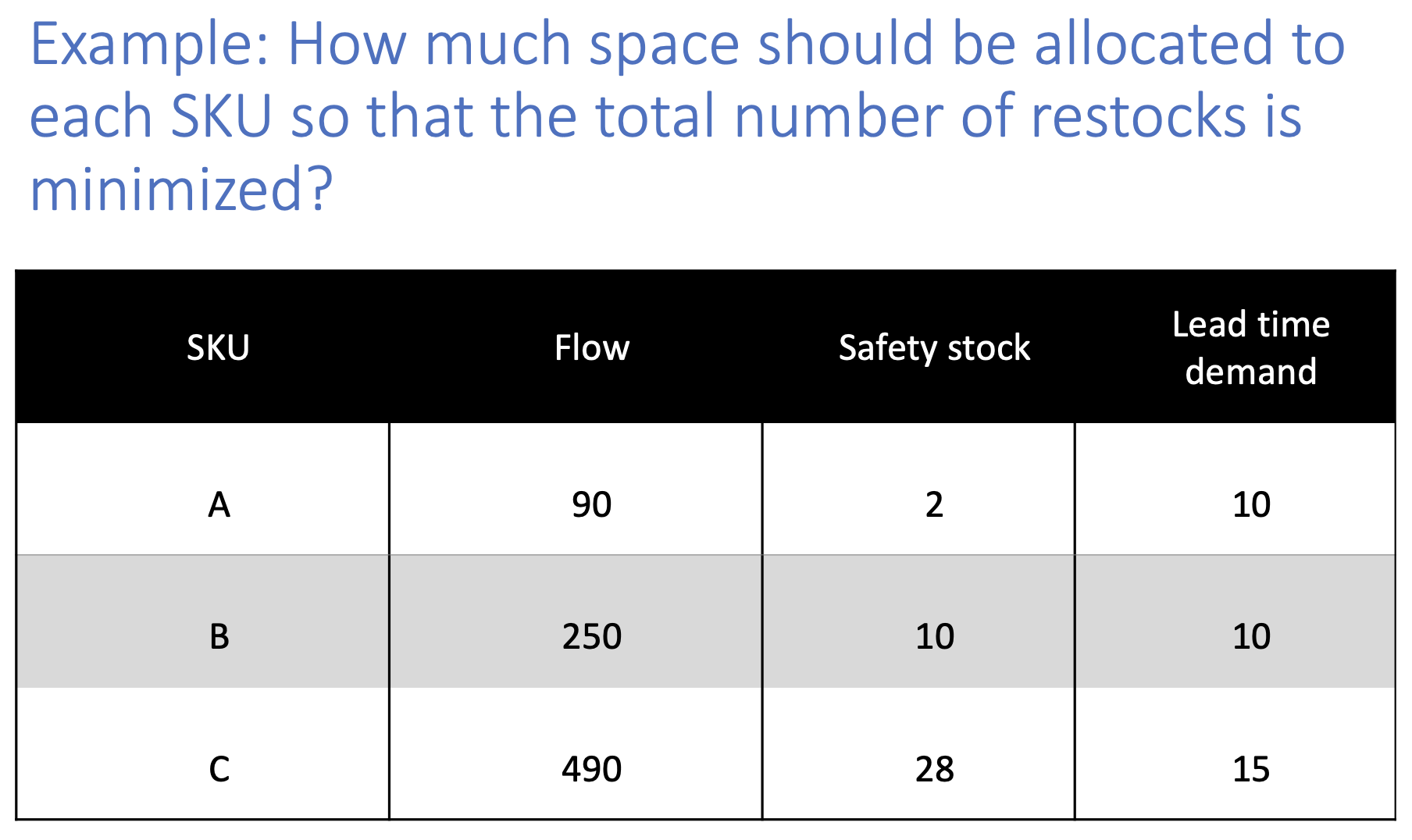
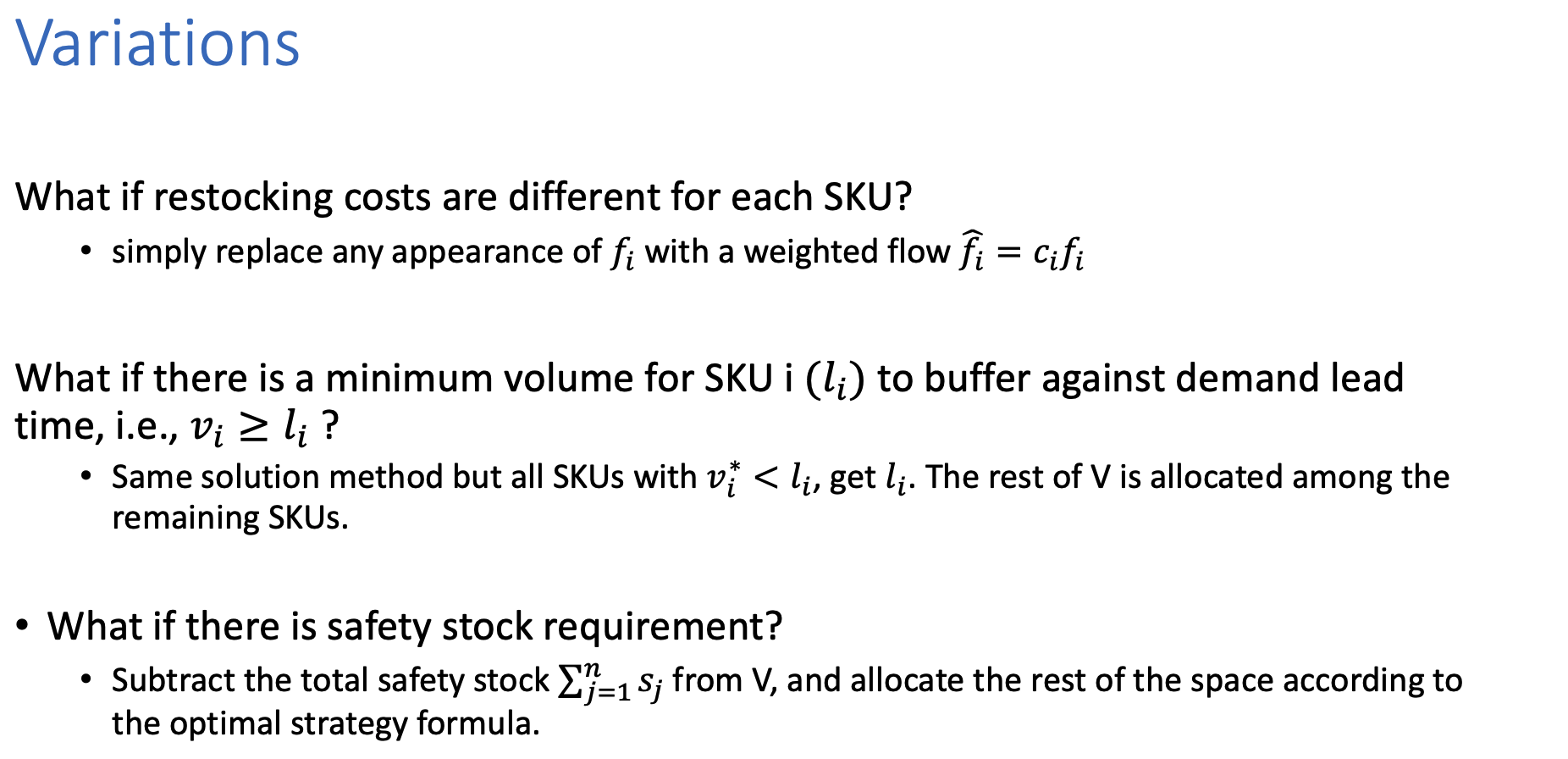
$V = 80-40 = 40
v^_A=\sqrt{90}/(\sqrt{90}+\sqrt{250}+\sqrt{490})=0.2
V^_A=0.240=8<10\implies V^_A=10$
$V=80-40-10=30
v^_B=\sqrt{250}/(\sqrt{250}+\sqrt{490})=0.42
V^_B=0.4230=12.6>10
V^_C=17.4>15$
therefore, $\boxed{V^_A=10, V^_B=12.6, V^*_C=17.4}$
2. Which SKUs should go into the forward area?
2.1 Obj: Maximize Net Benefit
If $n$ SKUs in forward area, each with flow $f_i$, suppose the total space is normalized to be $V=1$
\[\max \sum_i(sp_i-c_r\frac{f_i}{v_i})x_i\] \[s.t.\begin{cases} \sum_i v_ix_i &\leq 1\\ v_i&\geq 0\\ x_i&\in\{0,1\} \end{cases}\]Bang-for-buck \((sp_i-\frac{c_rf_i}{v_i})/v_i\)
$p_i$: number of picks $x_i$: whether or not to store SKU_i
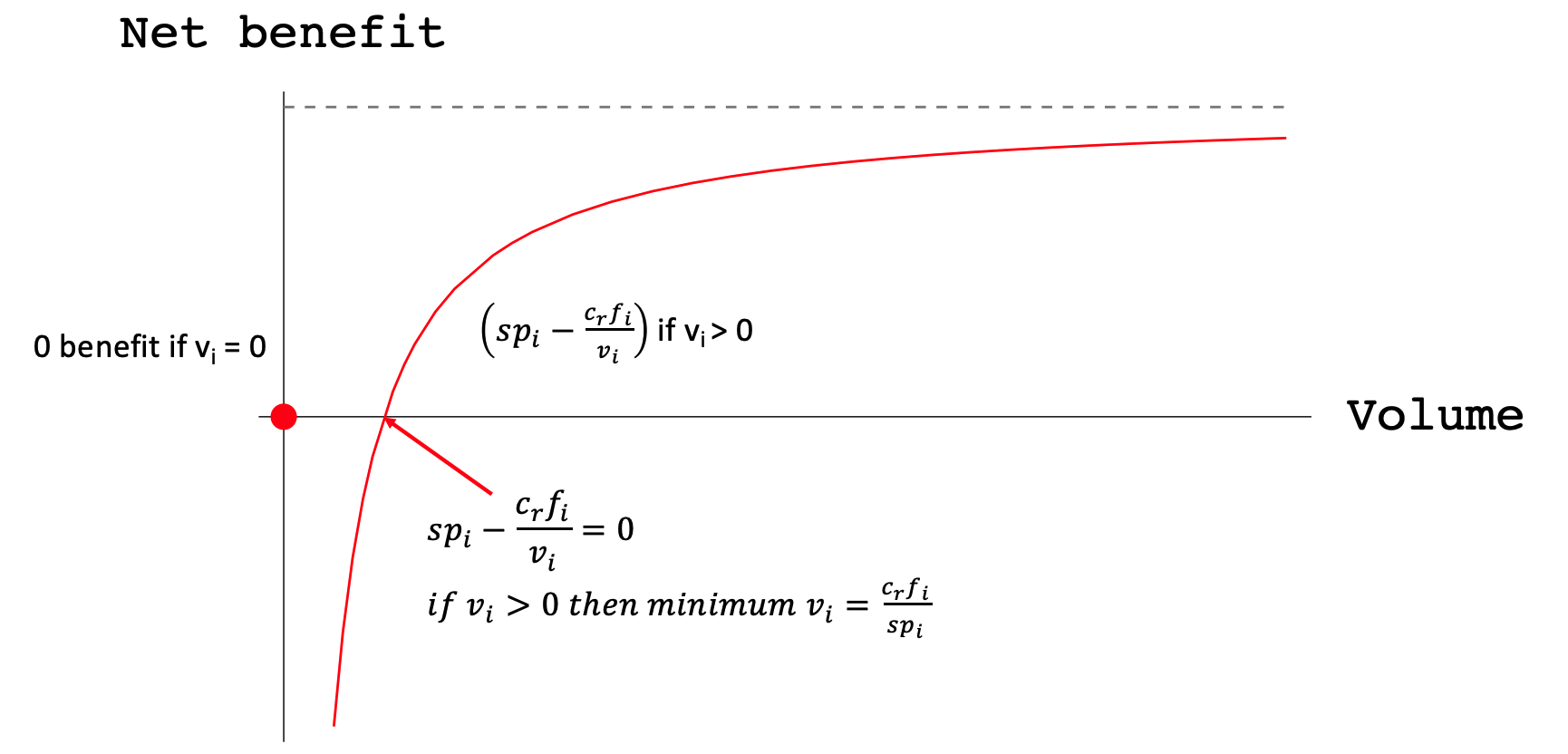
Knapsack: $v_i,x_i$ are all decision variables, which make the first constraint hard to consider
2.2 Determine $v_i$
To solve the knapsack above, we need to determine(fix) $v_i$. There are three possible ways including EQS, EQT and OPT, here we choose OPT:
\[\max \sum_i(sp_i-c_r\frac{f_i}{\frac{\sqrt{f_i}}{\sum\sqrt{f_i}}})x_i\]Sorting by $\frac{p_i}{\sqrt{f_i}}$ is equivalent to sorting by bang-for-buck = (这里式子很复杂,就是把 OPT 的 $v_i$ 带入 bang-for-buck 的公式中去)
Guest Lecture: FORTNA
Fortna designs distribution operations DC Design Methodology with a Focus of Picking Activity
Measure of Success improve our design
- quality and repeatability
- ability to scale the organization
improve our client’s ability to operate
1. Picking Methodologies Design
Three main steps of Design Methodology
- Inputs: Design, Requirements
- Construction: Picking, Methodology Selection and Feasibility
- Improvement: Technology & Refinement Optimization
1.1 Picking Methodologies
| Cluster Picking (Discrete Orders) | Batch Picking |
|---|---|
| picking one or multiple orders at a time directly to individual orders | picking multiple SKUs at a time without regrad to order integrity |
| does not require an extra-touch process to created the order | requires an extra-touch process coordinated over multiple areas to create the order |
| 优点: larger picking density, higher productivity |
Extra-Touch Methodologies
- Manual
- Automated Sortation w/no buffer (Unit Sorter)
- Automated Sortation with buffer (Pocket/Pouch Sorter) (buffer 可以避免产生需要先储存再运出去的麻烦)
1.1.2 How to compare?
|Cluster Picking| Batch Picking |-|-| |Cluster pick cart| Batch pick cart |Units per hour(UPH) 60 units/ 0.75 hr = 80 UPH| 40 units/ 0.4 hr = 100 UPH |No extra-touch| Extra-touch: manual put wall @ 200 UPH
Blended UPH = (1/UPH$P$ + 1/UPH${ET}$)$^{-1}$ Cluster Picking is better because $1/80 < (1/100+1/200)$
1.2 Solution Design
- Tri-delima: Cycle Time, Equipment & Systems, Productivity
2. Picking Technologies (Goods to Person)
| Tech | Pros | Cons |
|---|---|---|
| Autonomous Mobile Robotics with Movable Racks | - Flexibility in storage of product - Ease of deployment | - Utilization of cubic space - No ergonomic enhancements to picking |
| Aisle-Based Shuttle Systems | - High throughout possible - Ergonomic picking - Produt can be stored in totes, cases or cases on trays | - High capital, especially conveyor loop to network aisles to workstations - Cannot scale storage and throughput independently |
| Rack-Based Storage with Robots | - Ergonomic - Can scale storage and throughput independently - Eliminate need for a conveyor loop - Product can be stored in totes or cases on trays | - Aisles for AMR travel decrease storage density |
| Top-Loading Bins with Robots | - Highest cubic density of any GTP tech - Ergonomic - Can scale storage and throughput independently - Is often the lowest-cost solution | - Product must be stored in totes - Floors must be very flat - Workstations cannot achieve rate of some other GTPs - Digging buried bins increases the number of required robots - Well-publicized fire has led to required additional infrastructure |
Guest Lecture
What does it take to manage a warehouse in 2022?
Document Information
- Author: Zhekai Li
- Link: https://zhekaili.github.io/0007/02/01/ISYE6335-Layout-of-Piece-Picking-from-Cartons/
- Copyright: 自由转载-非商用-非衍生-保持署名(创意共享3.0许可证)