There are two “MCNF”s:
- Minimum Cost Network Flow
- Multi-commodity Network Flow (will be focused on)
1. MCNF: Minimum Cost Network Flow
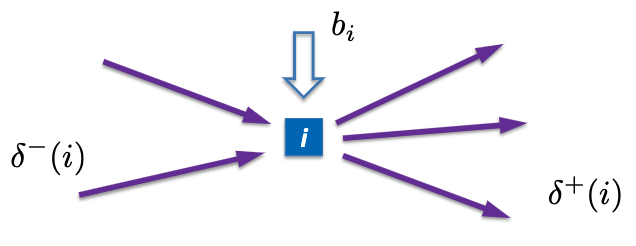
For a network model $G=(N,A)$, instead of using $(i,j)\in A$ to represent a arc/link, we apply $a\in A$ to represent
这是为了避免两条起点终点相同但是路径不同的路线共用一个名字
Decision Variables: $x_a$
Objective: minimize total cost \(\min \sum_{a\in A}c_ax_a\)
Constraints:
- $\sum_{i\in N}b_i=0$ (Node net supply)
- $l_a\leq x_a\leq u_a$ (Feasible flow bounds)
- $b_i=\sum_{a\in\delta^+(i)}x_a-\sum_{a\in\delta^-(i)}x_a$ (Feasible flow balance: net supply = demand-out - demand-in)
2. MCNF: Multi-commodity Network Flow
Service Network Design
MCNF: Multi-commodity/customer Network Flow Optimization
Container-level consolidation: shipments for multiple customers are consolidated into the same containers
A directed network: \(G=(N,A)\)
- $N$: nodes (decision points)
- $A$: arcs (allow representation of decisions)
Multiple “commodity” extension: we may manage multiple TYPES of flow $\to$ different types of flow use the same rescources! $\to$ Decision varaibles:
- $x_a^k$: decision flow for commodity $k$ on arc $a$
Notes: units of flow for all commodities should be identical (measure of size/time, e.g. lbs/week, TEU/month)
Example: For a given network model
graph LR;
A(A)
B(B)
C(C)
D(D)

A-->C
A-->B
A-->D
B-->C
B-->D
C-->D
we have:
- $G = (N,A)$
- $K={1,2}$
we can turn our origion model into two models:
- Flow $x_a^1$
: we have $b_i^1$ ```mermaid graph LR; A(A) B(B) C(C) D(D)
A–>C A–>B A–>D B–>C B–>D C–>D linkStyle 0,1,2,3,4,5 stroke:blue
- <font color='green'>Flow $x_a^2$</font>: we have $b_i^2$
```mermaid
graph LR;
A(A)
B(B)
C(C)
D(D)

A-->C
A-->B
A-->D
B-->C
B-->D
C-->D
linkStyle 0,1,2,3,4,5 stroke:green
Key constraints of MC-MCF (Multi-Commodity Min Cost Flow)
- Commodity-specific: “seperate” flow balance networks per $k$
- Bundled capacity constraints:
- flows of different commodities consume the same resrouces
- arc capacity for $a$: $u_a$ such that $x_a=\sum_{k\in K}x_a^k\leq u_a$
3. MCMC(N)F: Multi-commodity Min Cost (Network) Flow
TYPE I: Linear Programming Version
- (I.a) $c_a^k=c_a$ for common cost variant
- (I.b) $c_a^k$ for commodity specific costs
T-I.1 Arc-based model
\(\min \sum_ac_a\Big(\sum_kx_a^k\Big)\)
- Commodity-specific flow balance $\sum_{i\in\delta^+(i)} x_a^k - \sum_{i\in\delta^-(i)} x_a^k = b^k_i $
- Flow bundle capacity constraints $\sum_k x_a^k\leq u_a$
- Commodity-specific flow bounds $l_a^k\leq x_a^k\leq u_a^k$
T-I.2 Path-based model
For single-origin, single-destination problems, we can use path-based model to reduce the number of variables:
\[\min \sum_k\sum_{p\in P(k)}c_px_p^k\]- $\sum_{p\in P(k)}x_p^k = q_{o_kd_k}$
- $\sum_k\sum_{p\in P(k):a\in p}x_p^k\leq u_a$
where
- $P(k)$: paths for commodity $k$
- $c_p=\sum_{a\in p}c_a$
- 具体实现时可以引入一个 binary variable $\alpha_{a,p}=1$ 来表示 $\alpha\in p$, 以解决第二个 constraints 的 modelling 问题
Single-path Fomulation 重新定义 $x_p^k=1$ 来表示 path $p$ picked for commodity $k$:
\[\min \sum_k\sum_{p\in P(k)}c_pq_{o_kd_k}x_p^k\]- $\sum_{p\in P(k)}x_p^k = 1$
- $\sum_k\sum_{p\in P(k):a\in p}x_p^kq_{o_kd_k}\leq u_a$
TYPE II: Integer Programming Version
T-II.a
$x_a^k$ is integer valued, and all the other things are same to (I.a)
Theorem:
- Integer single-commodity min cost flow is efficiently solvable in poly time using LP when $b_i$ are integers
- Integer multi-commodity min cost flow in general is NP-hard (as hard as TSP)
Document Information
- Author: Zhekai Li
- Link: https://zhekaili.github.io/0007/04/03/ISYE6336-MCNF-(Multi-Commodity-Network-Flow)/
- Copyright: 自由转载-非商用-非衍生-保持署名(创意共享3.0许可证)