Probability - Basis
1. Basic Probability
Types of uncertainties
- Inherent variability or randomness
- Statistical uncertainty
- Measurement error
- Model error
- Human error
Statistical uncertatinty could be reduced through accumulation of data.
1.1 Basic Definitions
Trials (experiments or observations):
- probability is concerned with the outcome of trials
- trail refers to an event whose outcome is unknown
- e.g. flip 2 coins, roll a die
Sample Space $S$:
- the collection of all possible outcomes of a trial
- e.g. for flip 2 coins $S={HH,HT,TH,TT}$
Sample Point $x$: each indivisual outcome
Event $E$: any collection of sample points (subset of $S$)
General relation: $x\in S$, $E\subseteq S$, $S=\bar{E}\cup E$ Special case: $E=S$: certain event; $E=\empty$: null event
$P(E)$: likelihood of occurrence of event $E$ in its sample space $S$
Axioms: (1) $P(E)\geq 0$ (2) $P(S)=1$ (3) $P(\bar{E})= 1-P(E)$
1.2 Permutation, Combination
\[n\text{P}k=\frac{n!}{(n-k)!}\]Permutation: 从 n 个人中挑选 k 个排成一列,有多少种挑选及排列方式
公式只用于计算,其实是不好理解的。正确的理解方式为,第 1 个人有 n 种选择,第 2 个人有 n-1 种选择…第 k 个人有 n-k+1 种选择
\[n\text{C}k=\frac{n!}{(n-k)!k!}\]Combination: 从 n 个人中挑选 k 个,有多少种挑选方式
在 permutation 的基础上,去掉那些因为位置不同导致的重复
1.3 Relationship between Events
Mutually exclusive: $P(E,F)=0$ (不能同时发生)
- $P(E\cup F)=P(E) + P(F)$ if mutually exclusive
- $P(E\cup F)=P(E) + P(F) - P(E,F)$ if not mutually exclusive
Independent: $P(E,F)=P(E)P(F)$ (S.I. statistica)
- $P(E,F)=P(E)P(F\vert E)$ if dependent
- $P(E\vert F)=P(E)$ in other words
Two mutually exlusive events are dependent, 因为如果一个发生我们就知道另一个不会发生 ($P(E,F)=0$)
Conditional Independent: \(p(x,y\vert z)=p(x\vert z)p(y\vert z)\)
Complementary: $E\bar{F}=\emptyset$
Collective exhaustive events: $\bigcup_{i=1}^M E_i=S$
1.4 Random Varaibles
A ramdom variable is a mapping from sample space $S$ to a real number space $R$
e.g. Tossing tow coins, $S={HH,HT,TH,TT}$
denote $X$ as number of H, then $S_X={0,1,2}$
2. Multiple Events
For multiple events: $E_1,E_2,…,E_M$
2.1 Associate Properties
(1) $(E_1\cup E_2)\cup E_3 = E_1\cup(E_2 \cup E_3) = E_1\cup E_2\cup E_3$
(2) $(E_1E_2)E_3 = E_1(E_2E_3) = E_1E_2E_3$
2.2 De Morgan’s Rules
\(\tag{2.1}\overline{\bigcup_{i=1}^M E_i}=\bigcap_{i=1}^M \overline{E_i}\)
That is $\overline{E_i\cup E_2\cup…\cup E_M}=\overline{E_1}…\overline{E_M}$
\[\tag{2}\overline{\bigcap_{i=1}^M E_i}=\bigcup_{i=1}^M \overline{E_i}\]That is $\overline{E_1…E_M}=\overline{E_1}\cup\overline{E_1}\cup\overline{E_M}$
Representation through circuits
Let $E_i$ indicates the failure event of $i$-th component, and $E_{sys}$ indicates the whole system’s failure. The parallel and series circuits are shown below:
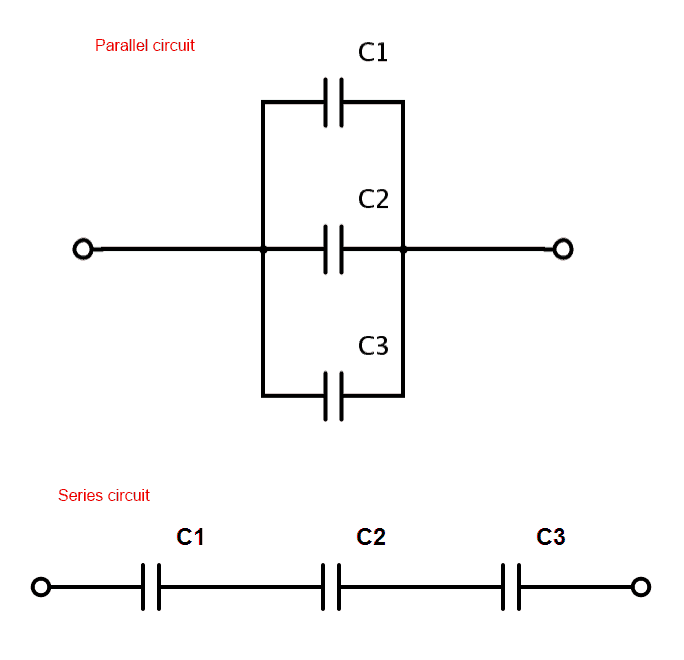
Series connections: $E_{sys} = E_1\cup E_2\cup E_3$, $\overline{E_{sys}}=\bar{E_1}\bar{E_2}\bar{E_3}$
Parallel connections: $E_{sys} = E_1E_2E_3$, $\overline{E_{sys}}=\bar{E_1}\cup\bar{E_2}\cup\bar{E_3}$
3. Rules of Probability Theory
3.1 Inclusion-Exclusion Rule
For simplest case: $P(E_1\cup E_2)=P(E_1) + P(E_2) - P(E_1E_2)$
For general cases: \(P(\bigcup_{i=1}^nE_i)=\sum_{i=1}^nP(E_i) - \sum_{i=1}^{n-1}\sum_{j=i+1}^nP(E_iE_j)+...+(-1)^{n-1}P(E_1E_2...E_n)\)
Statistical Independence
Two events are statistically independant (S.I.) if the occurrence of one event doesn’t change the probability of the other, that is, $P(E_1\vert E_2)=P(E_1)$ and $P(E_2\vert E_1)=P(E_2)$.
Only when $E_1,E_2$ are S.I., the formulation $P(E_1E_2)=P(E_1)\cdot P(E_2)$ works
3.2 Total Probability Rule
Let $E_1,E_2,…,E_M$ satisfy $\begin{cases}E_iE_j=\empty \text{ for any } i\neq j \ \bigcup_{i=1}^ME_i=S\end{cases}$
then $P(A)=\sum_{i=1}^MP(A\vert E_i)P(E_i)$
That’s because $=\sum_{i=1}^MP(A, E_i)=P(AE_1\cup…\cup AE_M)=P(A(E_1\cup…\cup E_M))=P(AS)=P(A)$
3.3 Bayes’s Rule
\[P(A\vert B)=\frac{P(B\vert A)}{P(B)}\cdot P(A)\]where
- $P(A\vert B)$ posterior probability
- $P(A)$ prior probability
- $P(B\vert A)$ likelihood
- $P(B)=P(B\vert A)P(A) + P(B\vert\sim A)P(\sim A)$
3.4 Other Calculations
$P(A,B)=P(A\vert B) P(B)$
$P(A,B\vert C)=P(A\vert B,C)P(B\vert C)$
$ $
Document Information
- Author: Zhekai Li
- Link: https://zhekaili.github.io/0007/12/31/PT-Basis/
- Copyright: 自由转载-非商用-非衍生-保持署名(创意共享3.0许可证)